
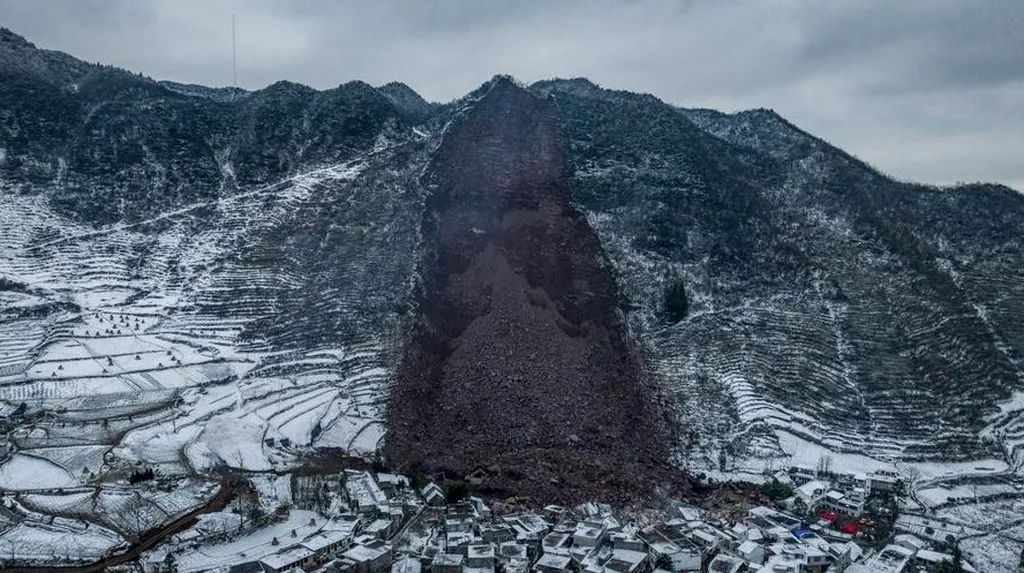
In the rugged terrain of the Wumeng Mountain area, an ancient landslide of monumental proportions has been quietly reshaping the landscape for millennia. Now, a team of researchers led by ZHU Sainan from the China Institute of Geo-Environment Monitoring in Beijing has unveiled the secrets of the Daguan ancient landslide, offering critical insights that could influence future infrastructure and energy projects in the region.
The Daguan landslide, with a staggering volume of 2.1×10⁸ cubic meters, has been dormant for approximately 35,000 years. However, the study published in ‘Yantu gongcheng xuebao’ (translated to ‘Geotechnical Engineering Journal’) reveals that this geological giant is not as dormant as once thought. “The landslide is currently experiencing creep deformation in multiple areas due to a combination of factors including rainfall, earthquakes, and human activities,” explains ZHU Sainan, the lead author of the study.
The research team employed a multidisciplinary approach, utilizing high-precision remote sensing, UAV surveys, field measurements, and numerical simulations to understand the landslide’s behavior. Their findings paint a picture of a complex geological history, with the landslide evolving over multiple periods, forming three distinct gentle slopes.
The implications for the energy sector are significant. The Wumeng Mountain area is rich in natural resources, and understanding the stability of the Daguan landslide is crucial for the safe development of infrastructure such as roads, pipelines, and power plants. The study’s numerical simulations under extreme rainfall and earthquake conditions revealed potential instability, with overall stability coefficients dropping to 0.98 and 0.93 respectively. “This suggests that under extreme conditions, the landslide could reactivate, posing a significant risk to nearby infrastructure,” warns YIN Yueping, a co-author from the same institute.
The research also highlights the importance of long-term monitoring and mitigation strategies. “Our findings provide a reference for the study of similar giant ancient landslides in canyon areas and offer valuable data for disaster prevention and mitigation,” adds ZHU Sainan.
As the energy sector continues to expand into remote and challenging terrains, the lessons from the Daguan landslide serve as a cautionary tale. The study underscores the need for thorough geological assessments and continuous monitoring to ensure the safety and sustainability of future projects. In an era of rapid development, understanding the whispers of the earth could mean the difference between progress and catastrophe.