
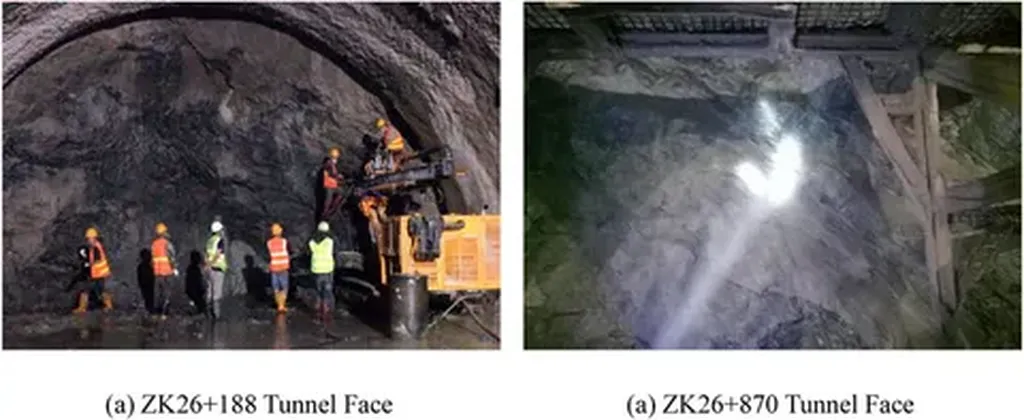
In the heart of Xi’an, China, a team of researchers from Chang’an University’s School of Highway has been delving into the intricate world of tunnel construction, particularly those built in fissured soil. Their recent study, led by QIU Junling and published in *Yantu gongcheng xuebao* (translated to *Rock and Soil Mechanics*), is shedding new light on how rainfall infiltration can impact tunnel stability, with significant implications for the energy sector.
The team’s research introduces a novel dual-channel seepage model, a concept born from observing local seepage behavior in soil layers with a single fissure. “We wanted to understand how water moves through these fissured soils and how that affects the tunnels we build,” QIU explains. By using a step function, they derived boundary conditions and transformation formulas for rainfall-induced seepage, a critical step in modeling the complex interactions between water and soil.
The researchers found that the accuracy of their model improved when they set the transition zone length to 4 or 8 units. They then used COMSOL Multiphysics to simulate these dual-channel seepage effects, exploring how the surrounding rock of tunnels in fractured soil deforms under rainfall infiltration.
Their findings are eye-opening. As rainfall time increases, the settlements of the arch and upper horizontal displacement of the tunnel near the fissure become significantly higher than those far from it. Moreover, the larger the fissure width, the faster the rainfall infiltration and expansion, leading to greater tunnel displacement. For instance, comparing a fissure width of 2 mm to one of 8 mm, the maximum settlement of the arch crown increased by 6.5%, and the maximum horizontal displacement of the upper part rose by 44%.
Interestingly, the intensity of rainfall had a relatively small impact on the surrounding rock of the tunnel, suggesting that the structure of the soil itself plays a more significant role in tunnel stability.
So, what does this mean for the energy sector? Tunnels are crucial for various energy infrastructure projects, from hydroelectric power plants to underground energy storage facilities. Understanding how rainfall infiltration affects tunnel stability in fissured soils can help engineers design more resilient and safer structures, reducing maintenance costs and preventing potential disasters.
As QIU puts it, “Our research provides a more accurate model for predicting tunnel deformation under rainfall infiltration, which can guide the design and construction of tunnels in similar geological conditions.”
This study is a significant step forward in tunnel engineering, offering valuable insights that could shape future developments in the field. By understanding and mitigating the risks posed by rainfall infiltration, we can build more robust energy infrastructure, ensuring a more sustainable and secure energy future.