
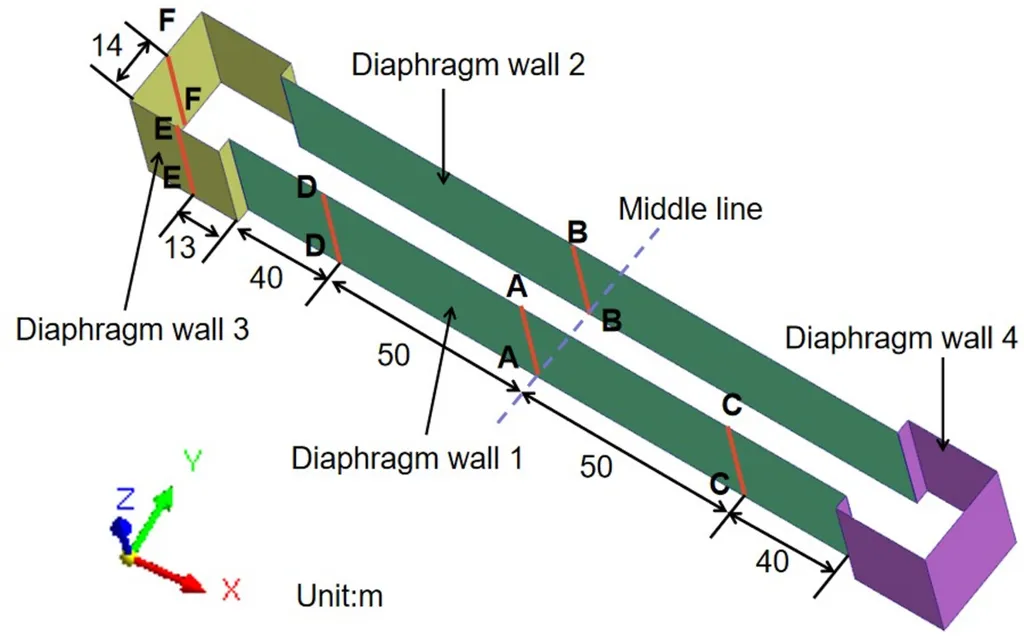
In the heart of China, researchers are unraveling the intricate dance of forces that diaphragm walls perform in the face of dewatering and excavation. A team led by Dr. Chi Minliang from Zhejiang University, along with colleagues from Hangzhou City University and East China Jiaotong University, has conducted a series of meticulous laboratory model tests to shed light on this complex interplay. Their findings, published in *Yantu gongcheng xuebao* (translated to English as *Rock and Soil Engineering*), could significantly impact the energy sector’s approach to large-scale construction projects.
The team simulated dry sand excavation and excavation with dewatering, collecting data on pore-water and earth pressures, settlements, bending moments, and lateral displacements. Their goal? To understand how these factors interact and influence the stress and deformation of diaphragm walls.
“Our results show that dewatering and excavation together change the distribution patterns of lateral earth pressures on both sides of the diaphragm wall,” explained Dr. Chi. “The changes are more pronounced than in dry sand excavation alone, with less passive earth pressure in front of the wall and the peak positions of lateral earth pressures behind the wall moving downwards.”
This research is not just about understanding the mechanics; it’s about practical implications. In the energy sector, large-scale construction projects often involve deep excavations and dewatering. The findings suggest that engineers may need to reconsider their approaches to ensure the stability and safety of diaphragm walls under these combined conditions.
Dr. Liang Luju, a co-author from Hangzhou City University, emphasized the importance of these findings: “By understanding these mechanisms, we can better predict the behavior of diaphragm walls and optimize our designs. This could lead to more efficient and safer construction practices, ultimately benefiting the energy sector.”
The research also highlights the need for advanced monitoring techniques. As Dr. Xu Changjie from East China Jiaotong University noted, “Accurate data collection is crucial. Our model tests provide a controlled environment to study these complex interactions, but real-world applications will require robust monitoring systems to ensure safety and efficiency.”
The implications for the energy sector are significant. As projects grow larger and more complex, understanding the stress and deformation mechanisms of diaphragm walls under combined effects of dewatering and excavation becomes increasingly important. This research could pave the way for more innovative and resilient construction practices, ensuring the stability and safety of critical infrastructure.
In the ever-evolving landscape of construction and energy, this study stands as a testament to the power of scientific inquiry. By delving deep into the mechanics of diaphragm walls, Dr. Chi and his team are not just advancing our understanding; they are shaping the future of large-scale construction.