
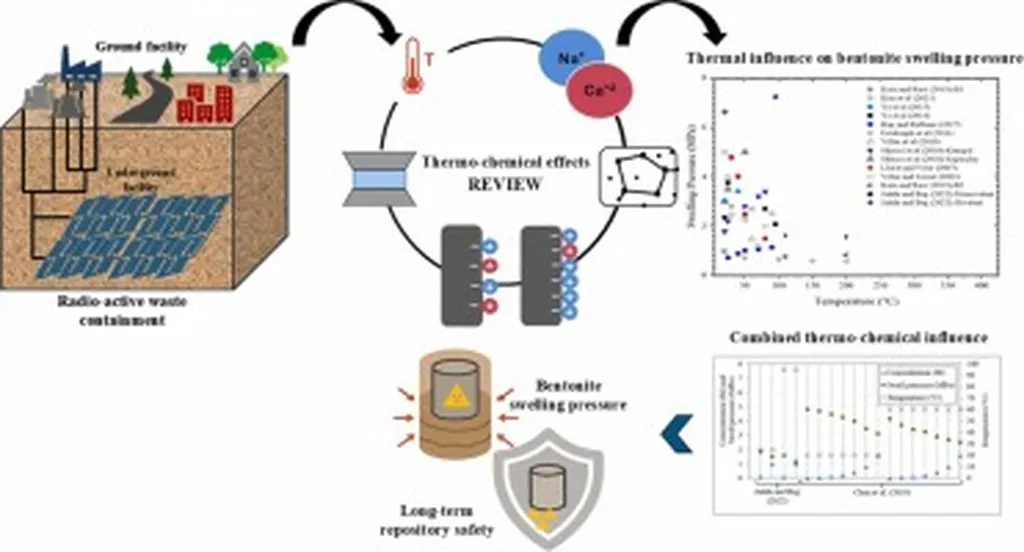
In the quest for safe and effective nuclear waste disposal, understanding the long-term behavior of materials used in deep geological repositories is paramount. A recent study published in *Yantu gongcheng xuebao* (Chinese Journal of Geotechnical Engineering) sheds light on how thermal aging affects the barrier properties of bentonite, a critical buffer material in high-temperature conditions. Led by Zhaotian Zeng from Guilin University of Technology, the research team explored the intricate relationship between thermal aging time and the performance of MX80 bentonite, offering insights that could shape the future of nuclear waste management.
Bentonite, a type of clay, is widely used as a buffer material in nuclear waste repositories due to its excellent swelling and sealing properties. However, the long-term stability of these properties under high-temperature conditions has been a subject of concern. Zeng and his team subjected MX80 bentonite to high temperatures of 200℃ for varying durations, ranging from 0 to 120 days, to study the evolution of key engineering barrier performance parameters such as thermal conductivity, constant volume expansion force, unconfined compressive strength, and specific surface area.
The results were striking. “We observed a significant time effect, particularly within the first 15 days of thermal aging, where the decay rate of these parameters ranged from 56.89% to 68.51%,” Zeng explained. This rapid degradation highlights the critical importance of understanding the short-term behavior of bentonite in high-temperature environments.
The study also delved into the micro-mechanisms driving these changes. Using advanced techniques like X-ray diffraction, thermogravimetric analysis, and scanning electron microscopy, the researchers found that high-temperature aging led to the partial transformation of montmorillonite minerals into sodium mica, loss of adsorbed water, and changes in the soil microstructure. These microscopic alterations were directly correlated with the observed degradation in barrier properties.
The implications of this research are profound for the energy sector, particularly in the realm of nuclear waste disposal. “Our findings suggest that the transformation of mineral composition, loss of adsorbed water, and evolution of soil microstructure are the primary factors influencing the barrier properties of bentonite,” said Zeng. This understanding could lead to the development of more robust and durable buffer materials, ensuring the long-term safety and stability of nuclear waste repositories.
As the world continues to grapple with the challenges of nuclear waste management, this research offers a crucial step forward. By unraveling the micro-mechanisms behind the thermal aging of bentonite, Zeng and his team have provided valuable insights that could shape the future of nuclear waste disposal technologies. The study, published in *Yantu gongcheng xuebao*, serves as a testament to the ongoing efforts to enhance the safety and efficiency of nuclear energy, paving the way for a more sustainable and secure energy future.