
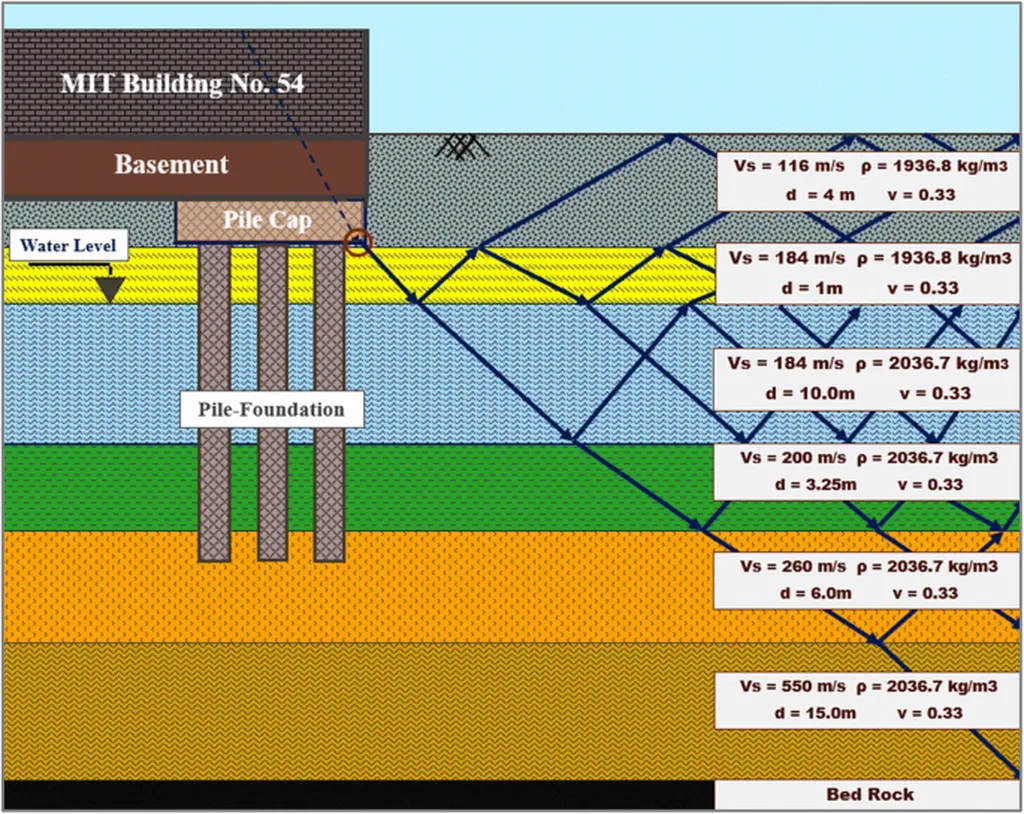
In the realm of construction and geotechnical engineering, a groundbreaking study has emerged that could significantly impact how we approach seismic design, particularly in soft soil sites. Led by Dr. Lan Jingyan from the School of Civil Engineering at Guilin University of Technology, the research delves into the intricate dynamics of pile-soil systems under seismic conditions. The findings, published in *Yantu gongcheng xuebao* (Chinese Journal of Geotechnical Engineering), offer valuable insights that could reshape industry practices, especially in the energy sector where stable foundations are paramount.
The study employs advanced finite element modeling using ABAQUS software, enhanced with an equivalent linearization model to capture the dynamic nonlinear behavior of soils. This approach allows for a detailed analysis of how pile foundations interact with the soil during seismic events. “Understanding these interactions is crucial for designing structures that can withstand earthquakes, particularly in areas with soft soil,” explains Dr. Lan.
One of the key findings is the identification of a “waist cinching” phenomenon near the surface of the pile body, where the bending moment is highest. This insight is critical for engineers designing pile foundations in seismic zones. “The bending moment value of the pile body is the highest at the middle and lower positions, which can lead to structural vulnerabilities if not properly accounted for,” Dr. Lan notes.
The research also reveals that as the burial depth of the soil layer decreases, the peak displacement gradually increases, with the maximum value appearing at the surface. This finding underscores the importance of considering surface conditions in seismic design. Additionally, the study shows that the peak acceleration amplification factor of soils exhibits a trend of first decreasing and then increasing with the decrease of burial depth. The cumulative absolute velocity amplification factor is greatest at the surface, highlighting the sustained effects of seismic motion.
For the energy sector, these findings are particularly relevant. Pile foundations are often used in offshore wind farms, oil and gas platforms, and other energy infrastructure projects. Ensuring the stability of these structures under seismic conditions is essential for preventing catastrophic failures and ensuring operational continuity. “This research provides a more accurate understanding of the seismic response of pile-soil systems, which can lead to more robust and cost-effective designs,” says Dr. Lan.
The study’s validation through comparisons with centrifugal model test results further reinforces the feasibility of the numerical model. This validation is a significant step forward in the field, as it bridges the gap between theoretical modeling and real-world applications.
As the energy sector continues to expand into more challenging environments, the insights from this research will be invaluable. By incorporating these findings into design practices, engineers can create more resilient structures that can withstand the forces of nature. “The ultimate goal is to enhance the safety and reliability of our infrastructure, ensuring that it can withstand the unpredictable forces of nature,” Dr. Lan concludes.
In the broader context, this research opens up new avenues for further exploration. Future studies could delve deeper into the specific mechanisms driving the observed phenomena, as well as explore the potential for integrating these findings into building codes and design standards. As the field of geotechnical engineering continues to evolve, the work of Dr. Lan and his team serves as a beacon of innovation, guiding the way toward a more resilient and sustainable future.