
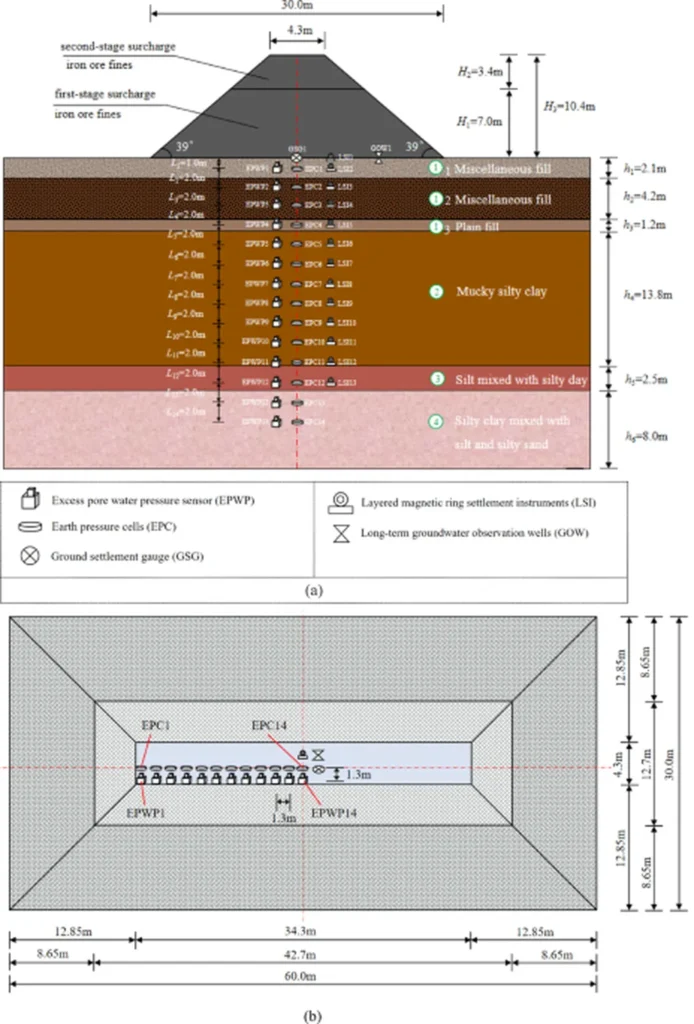
In the realm of expressway reconstruction and extension, particularly in soft soil areas, the challenge of managing differential settlement between new and old road foundations has long been a critical issue. A recent study published in *Yantu gongcheng xuebao* (translated to *Rock and Soil Engineering*) sheds new light on this problem, offering insights that could significantly impact the construction and energy sectors.
Led by LI Xingming of Hubei Land Resources Vocational College, the research team conducted extensive settlement monitoring on expressway projects, focusing on the behavior of new and old roadbeds. Their findings reveal a distinctive “W” type settlement pattern, where the new roadbeds on either side experience more substantial settlement compared to the original roadbed in the middle. This discovery is crucial for understanding the long-term stability of expressway foundations.
“The settlement of the newly built roadbed is significantly larger during the filling period but stabilizes considerably afterward,” explains LI Xingming. “Interestingly, the filling of the new embankment has minimal impact on the settlement of the old road foundation, which is a critical factor for ensuring the longevity and safety of these structures.”
Using the hyperbolic model, the researchers calculated the final settlement of the newly built roadbed to be 82.52 mm, with a projected settlement of 80.01 mm over 15 years post-construction. For the old road foundation, the final settlement was determined to be 20.79 mm, with a 15-year projection of 19.15 mm. These calculations provide a robust framework for predicting and managing settlement in future projects.
One of the most significant findings of the study is the effectiveness of PC pipe piles in treating soft soil subgrades. The research demonstrates that using PC pipe piles results in significantly better differential settlement control compared to untreated subgrades. This method not only enhances the stability of the roadbeds but also ensures the safety and durability of the infrastructure.
The implications of this research are far-reaching, particularly for the energy sector, where the stability of transportation networks is paramount. “Understanding and mitigating differential settlement is crucial for the safe and efficient transport of energy resources,” notes LI Xingming. “Our findings provide a scientific basis for optimizing construction techniques and ensuring the long-term stability of expressways in soft soil areas.”
As the construction industry continues to evolve, the insights from this study will be invaluable for engineers and planners. By adopting the recommended techniques, they can enhance the durability and safety of expressway projects, ultimately benefiting the energy sector and the broader economy.
The research, published in *Yantu gongcheng xuebao*, represents a significant step forward in the field of geotechnical engineering. It underscores the importance of continuous monitoring and innovative treatment methods in addressing the challenges posed by soft soil foundations. As the industry moves forward, these findings will undoubtedly shape the future of expressway construction and extension projects.