
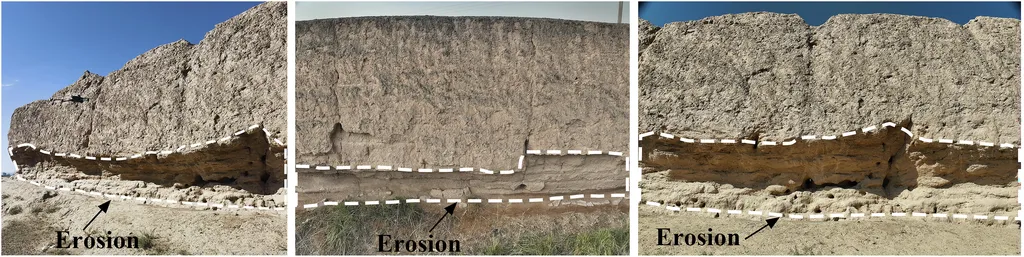
In the heart of China, where ancient rammed earth sites stand as testaments to time, a team of researchers from Lanzhou University of Technology is tackling a modern challenge: preventing cracks at the interface between old and new earth structures. Led by Dr. Cui Kai of the Western Civil Engineering Disaster Prevention and Mitigation Education Ministry Engineering Research Center, the team’s work could have significant implications for the energy sector, particularly in areas where rammed earth construction is prevalent.
The problem is a common one. When reinforcing the erosion-prone bases of rammed earth sites, cracks often form at the interface between the original structure and the new supplementary earth. These cracks can compromise the structural integrity of the site, leading to costly repairs and potential safety hazards. “The interface cracking is a critical issue that needs to be addressed to ensure the longevity and safety of these historic structures,” Dr. Cui explained.
To tackle this issue, the team conducted on-site experiments with four different crack prevention measures: no-crack measures (WZ), setting a cushion layer (DC), interface anchoring (MG), interface grooving (KC), and a combination of all three (DMK). They monitored the strain and moisture content continuously and synchronously, providing a comprehensive picture of the crack development process.
Their findings, published in the journal *Yantu gongcheng xuebao* (which translates to *Rock and Soil Engineering*), revealed that the combined measure (DMK) showed the best crack prevention effects. “The interface bonding strength is mainly borne by the interfacial adhesion, anchoring force of the anchor bolts, the friction and shear pin force, and the interlocking and bonding forces of the groove,” Dr. Cui noted.
The research is not just about preserving history; it has significant commercial impacts for the energy sector. Rammed earth construction is often used in renewable energy projects, such as wind farms and solar power plants, due to its low environmental impact and cost-effectiveness. By preventing interface cracks, this research could help ensure the stability and longevity of these structures, reducing maintenance costs and improving safety.
The team’s work is a step forward in the field of rammed earth construction, but it also raises questions about the future of this ancient building technique in the modern world. As Dr. Cui put it, “This research is just the beginning. We need to continue exploring new methods and materials to improve the durability and performance of rammed earth structures.”
The energy sector, in particular, could benefit from further research in this area. As the world shifts towards renewable energy, the demand for sustainable and cost-effective construction methods is likely to increase. Rammed earth construction, with its low environmental impact and potential for energy efficiency, could play a significant role in this transition.
In the meantime, the team’s findings provide a valuable guide for engineers and architects working on rammed earth sites. By implementing the crack prevention measures outlined in this research, they can help ensure the stability and longevity of these structures, preserving our cultural heritage for future generations.