
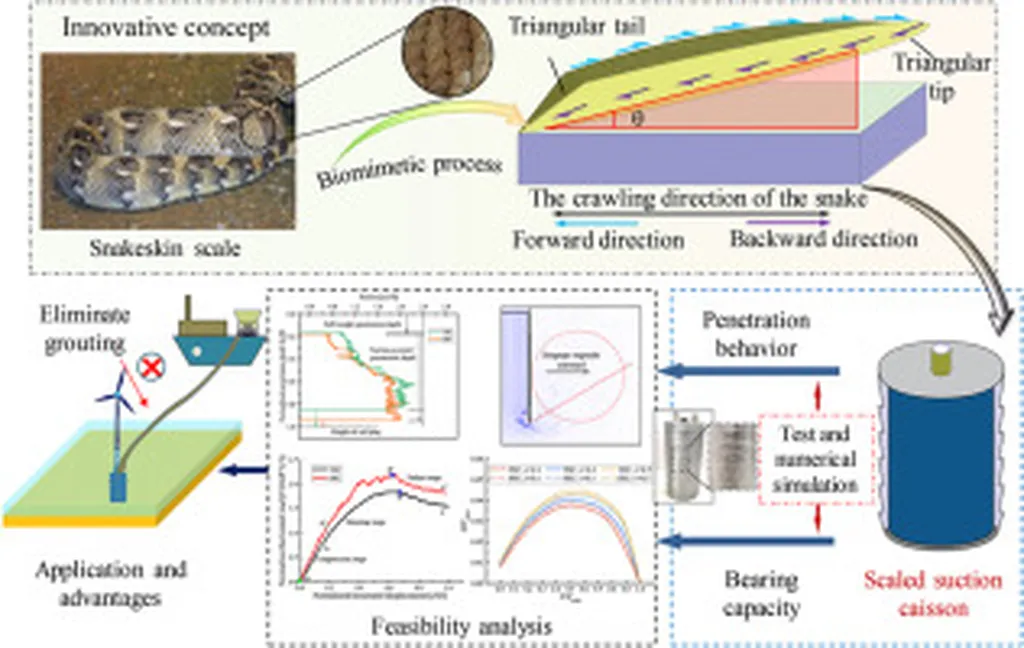
In the realm of offshore engineering, the installation of foundations is a critical process that demands precision and minimal environmental impact. A recent study published in *Yantu gongcheng xuebao* (Chinese Journal of Geotechnical Engineering) sheds new light on the behavior of sand during the installation of suction caisson foundations, offering insights that could revolutionize the energy sector’s approach to offshore construction.
Suction caissons, a popular choice for offshore structures due to their low-noise and low-environmental-impact installation, rely on suction-assisted penetration. However, determining the critical suction—the point at which excessive soil deformation and soil plug formation occurs—has been a challenge. Enter a team of researchers led by SHEN Kanmin from PowerChina Huadong Engineering Corporation Limited and LUO Xinquan from Tongji University. Their work combines physical model tests and numerical simulations to unravel the complexities of soil displacement and seepage response under varying suction levels and embedment ratios.
The study reveals that as suction increases, the vertical displacement of the soil begins to escalate rapidly, accompanied by a sudden increase in soil permeability. This abrupt change serves as a crucial indicator for determining the critical suction. “The abrupt increase in soil displacement can be used as a criterion for determining critical suction,” explains LUO Xinquan, a lead author from Tongji University. This finding is a game-changer, as it provides a clear, measurable benchmark for engineers to ensure safe and efficient installation.
Moreover, the research shows that the critical suction increases significantly with the embedment depth over diameter ratio of the foundation. For smaller embedment ratios, the soil inside the caisson exhibits a wedge-shaped failure under critical suction, while larger embedment ratios lead to a global upward heave failure mode. These insights are invaluable for optimizing the design and installation of suction caissons, particularly in the energy sector where offshore structures are prevalent.
The commercial implications of this research are substantial. By accurately determining the critical suction, energy companies can prevent costly installation failures and ensure the longevity of their offshore structures. “This research provides a robust framework for predicting soil behavior during suction caisson installation, which can significantly enhance the reliability and cost-effectiveness of offshore projects,” says SHEN Kanmin, the lead author from PowerChina Huadong Engineering Corporation Limited.
As the energy sector continues to expand into deeper and more challenging offshore environments, the need for innovative foundation solutions becomes ever more pressing. This study, published in *Yantu gongcheng xuebao*, offers a vital step forward, equipping engineers with the tools they need to navigate the complexities of soil behavior and ensure the success of future offshore projects. The findings not only advance our understanding of suction caisson installation but also pave the way for more sustainable and efficient practices in the energy sector.