
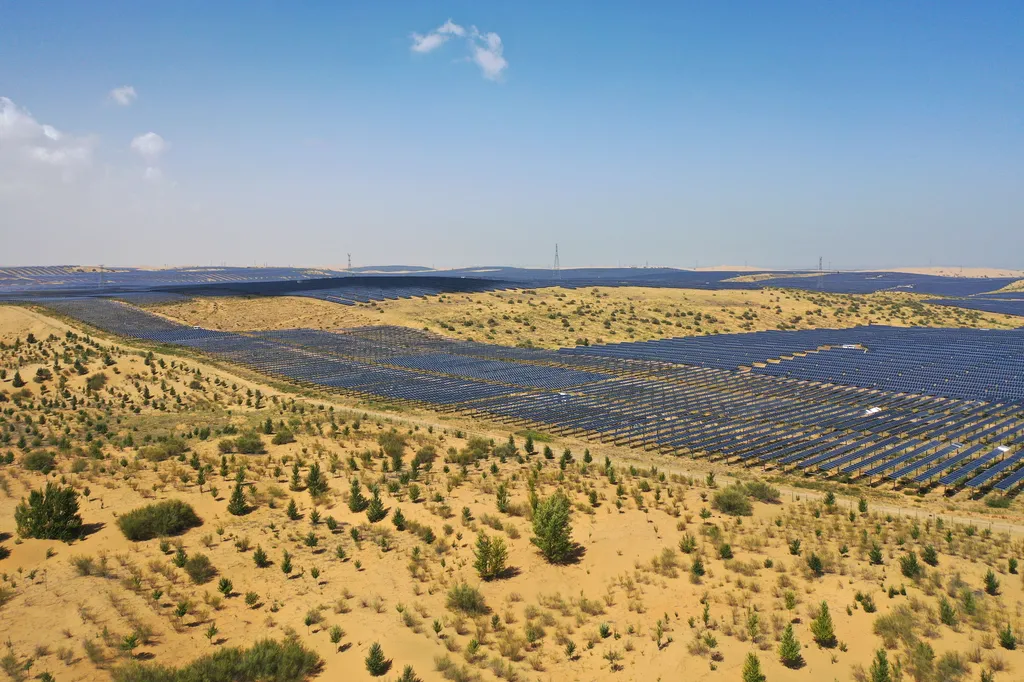
In the vast, windswept expanses of western China, where aeolian sand stretches as far as the eye can see, engineers and researchers are grappling with the challenges of building on loose, non-cohesive soil. A recent study published in *Yantu gongcheng xuebao* (translated as *Rock and Soil Engineering*) offers a promising new approach to understanding and working with these tricky terrains, with significant implications for the energy sector.
The research, led by FU Sai of PowerChina Huadong Engineering Corporation Limited and LI Baojian of Zhejiang University, focuses on the static cone penetration test (CPT), a widely used technique for obtaining soil characteristic information. The team employed a material point method (MPM) that combines the advantages of grid and particle methods to establish a numerical model for cone penetration tests in sandy soil. This innovative approach allows for more accurate simulations of the large deformation problems that occur during the penetration process.
One of the key aspects of their study is the use of the state-dependent Mohr-Coulomb criterion, which captures the relationship between the void ratio and the mean stress using a relatively simple set of soil parameters. “This criterion is crucial for understanding the behavior of aeolian sand, as it allows us to model the soil’s response to penetration more accurately,” explains FU Sai.
The researchers first validated their model by comparing it with a well-tested calibration chamber test, ensuring the accuracy of their simulations. They then changed the initial void ratio of the computational domain to simulate the loose state of aeolian sand. Through a series of cone penetration tests, they explored the relationship between the cone penetration resistance and the initial void ratio of aeolian sand.
Their findings are significant for the energy sector, particularly for the construction of wind farms and other infrastructure in aeolian sand areas. “We found that the penetration resistance decreases nonlinearly with the increase of the initial void ratio,” says LI Baojian. “However, the stable value of the penetration resistance in loose sand does not change with the initial void ratio. This means that we can use a relative material saving method to select the design parameters in engineering, improving the economic benefits of engineering construction in aeolian sand areas.”
This research could shape future developments in the field by providing a more accurate and efficient way to model soil behavior in aeolian sand areas. By understanding the relationship between penetration resistance and initial void ratio, engineers can optimize their designs, reducing material costs and improving the stability of structures built on these challenging terrains.
As the energy sector continues to expand into remote and challenging environments, the insights gained from this study will be invaluable. By offering a more precise and cost-effective approach to soil testing and modeling, this research paves the way for more sustainable and economically viable energy projects in aeolian sand areas.