
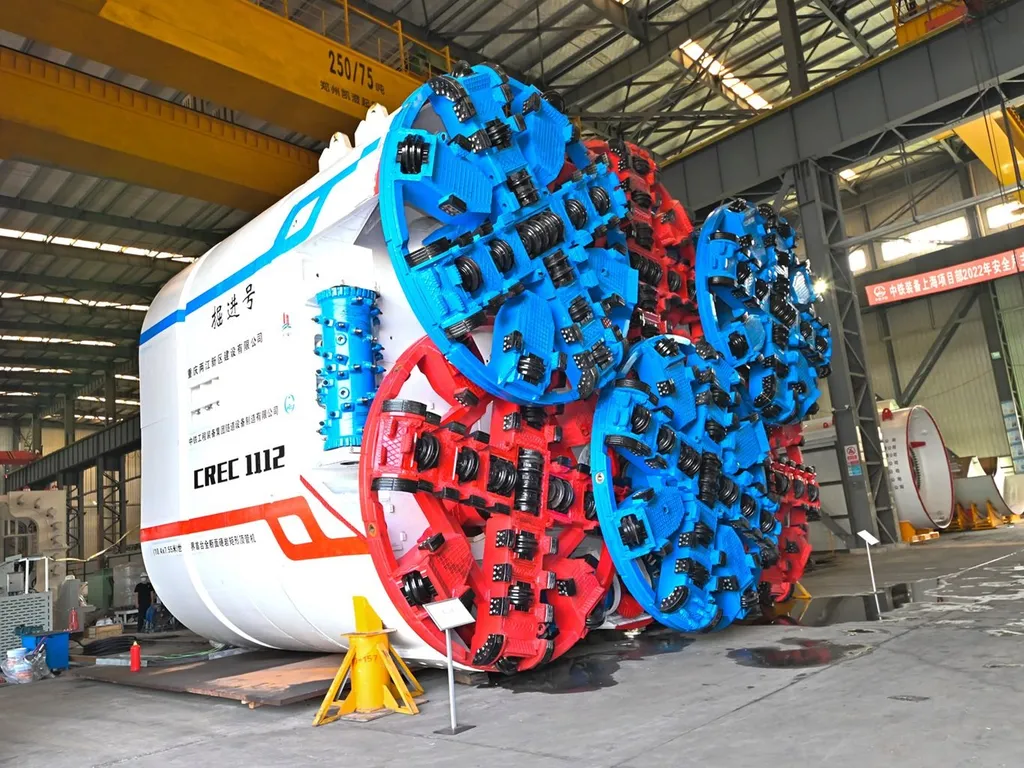
In the heart of Shanghai, beneath the bustling streets, a groundbreaking study is reshaping our understanding of underground construction. Researchers from the Shanghai Urban Construction Design & Research Institute and Tongji University have delved into the complexities of large-section rectangular pipe jacking in soft soils, shedding light on critical factors that could revolutionize urban infrastructure projects worldwide.
The study, led by ZHANG Zhongjie and Lianbin Long from Tongji University’s Department of Geotechnical Engineering, focuses on the Jing’an Temple Station Project of Shanghai Metro Line 14. This project, deeply buried in soft soils, presented unique challenges and opportunities for understanding the behavior of large-section rectangular pipe-jacking structures.
“Our research highlights the significance of water and earth pressures and internal force responses in ensuring the long-term safety of urban underground spaces,” said Long. The team’s findings reveal that the vertical earth pressures at the top of the structures align closely with theoretical values of soil column weight, suggesting minimal soil arching effects. This insight is crucial for accurate structural design and safety assessments.
One of the most compelling discoveries is the “butterfly-shaped” distribution of bending moments in quasi-rectangular pipe jacking. This pattern indicates a deformation mode that is vertically concave and transversely convex, leading to horizontal ground reactions. “The horizontal soil reactions can significantly impact the internal force of these structures,” explained Long. “Current design specifications often overlook this factor, potentially leading to a substantial overestimation of structural bending moments.”
The implications of this research extend far beyond Shanghai’s metro system. As cities worldwide expand their underground infrastructure, the need for accurate and efficient construction methods becomes paramount. The energy sector, in particular, stands to benefit from these findings. Underground pipelines, tunnels, and storage facilities are critical components of energy distribution and storage systems. Ensuring their safety and longevity is essential for maintaining reliable energy supplies.
“Our study provides a foundation for more precise design methods and better safety assessments,” said Long. “This can lead to more efficient and cost-effective construction processes, ultimately benefiting the energy sector and other industries reliant on underground infrastructure.”
The research, published in the journal ‘Yantu gongcheng xuebao’ (translated to ‘Chinese Journal of Geotechnical Engineering’), offers a comprehensive analysis of earth pressure distribution and structural response analysis. It challenges existing design methods and paves the way for future advancements in the field.
As urbanization continues to accelerate, the demand for underground space will only grow. This study not only addresses current challenges but also anticipates future needs, making it a cornerstone for the next generation of underground construction projects. With its focus on accuracy, safety, and efficiency, this research is set to shape the future of urban infrastructure and energy distribution systems worldwide.