
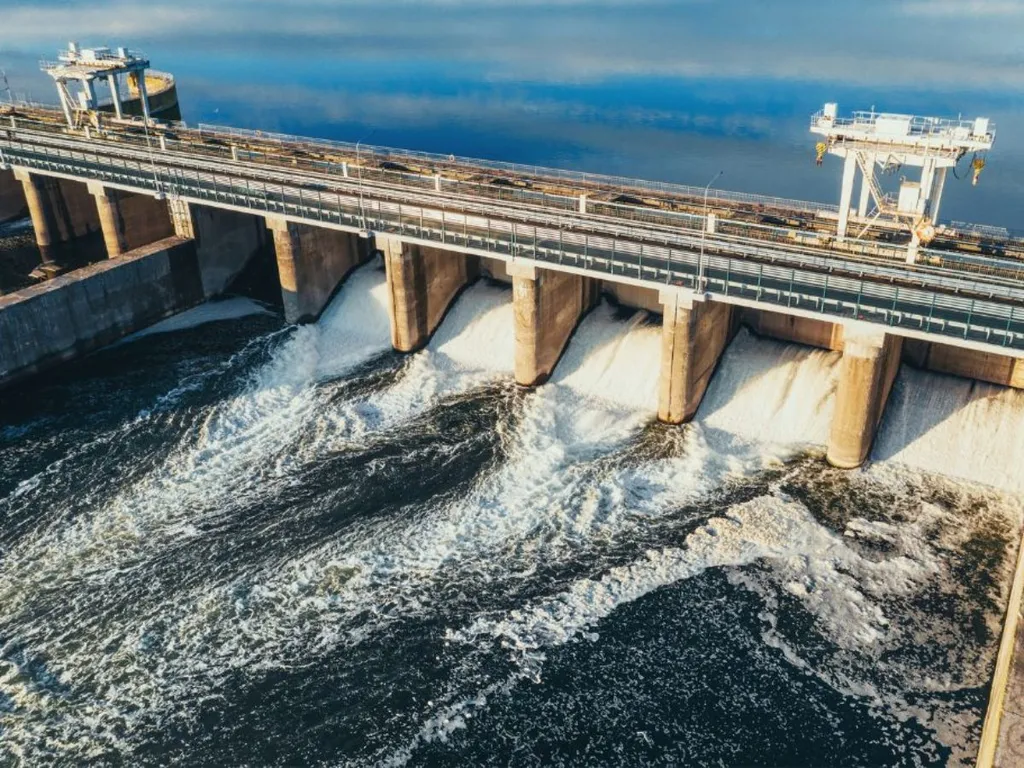
In the heart of China’s Sichuan province, the Baihetan Hydropower Station stands as a testament to human ingenuity and engineering prowess. But behind the scenes, researchers are delving into the very foundations of such monumental projects, quite literally. A recent study published in *Yantu gongcheng xuebao* (translated to *Rock and Soil Engineering*) has shed new light on the behavior of coarse-grained soils, with significant implications for the energy sector.
The research, led by Dr. Liang Yuzhen from Tongji University’s Department of Geotechnical Engineering, explores how particle size and shape influence the crushing strength of gravel soils. This might sound like a niche topic, but it’s a critical factor in the stability and safety of large-scale infrastructure projects, particularly in hydropower.
“We found that the crushing strength of individual particles is significantly affected by their size,” Dr. Liang explained. “The larger the particle, the lower its characteristic crushing strength.” This size effect is not just a theoretical curiosity; it has practical implications for the design and construction of dams and other energy infrastructure.
The study also found that particle shape plays a crucial role in crushing behavior. To incorporate this factor, the researchers used an innovative approach: artificial neural networks to calculate a shape factor. This allows for a more accurate prediction of crushing strength distribution, taking into account both size and shape.
The research then evaluated the applicability of the Weibull model, a statistical tool often used in reliability engineering, to describe the size effects on crushing strength. This could pave the way for more accurate predictive models in geotechnical engineering.
So, why does this matter for the energy sector? Well, understanding the crushing behavior of coarse-grained soils can help engineers design more stable and durable structures. This is particularly important for hydropower projects, which often involve large-scale earthworks and require a deep understanding of soil mechanics.
Dr. Gu Xiaoqiang, a co-author from Zhejiang Sci-Tech University, highlighted the potential commercial impacts: “By improving our understanding of soil behavior, we can optimize design parameters, reduce material usage, and ultimately lower construction costs. This is a win-win for both the environment and the bottom line.”
The study’s findings could also have implications for other sectors that rely on a deep understanding of soil mechanics, such as mining, tunneling, and offshore wind farm construction.
As the world continues to grapple with climate change and the need for sustainable energy solutions, research like this is more important than ever. By improving our understanding of the very ground we build upon, we can create more resilient and efficient infrastructure for the future.
In the words of Dr. Liang, “This is not just about advancing scientific knowledge. It’s about building a more sustainable world, one particle at a time.”