
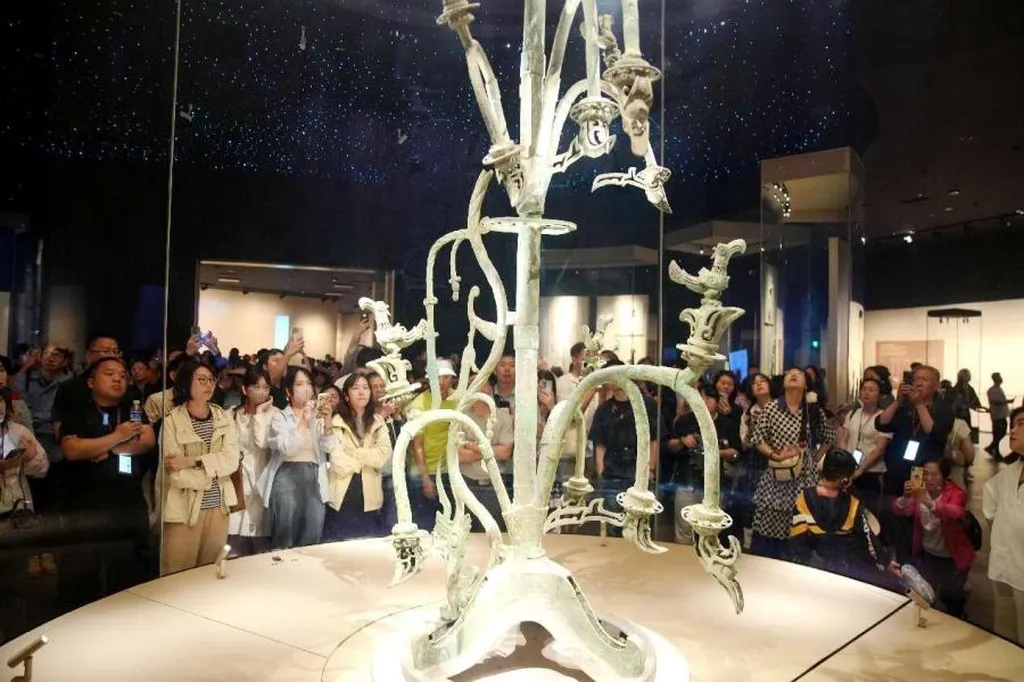
In the heart of Sichuan, China, a groundbreaking study is unearthing not just ancient artifacts, but also the secrets of soil behavior that could revolutionize the way we approach construction and preservation in archaeological sites. Led by ZHAO Fan of the Sichuan Provincial Cultural Relics and Archeology Research Institute, a team of researchers has been meticulously monitoring the desiccation cracking process in the sacrifice area of the Sanxingdui Ruins site, shedding light on the intricate dance between soil and environment.
Desiccation cracking, a phenomenon where soil dries and cracks, is a common issue in construction, particularly in areas with significant moisture fluctuations. The Sanxingdui site, with its rich clay soil and unique environmental conditions, provides an ideal natural laboratory for studying this process. “The development of desiccation cracking is a complex interplay of morphological evolution and dimensional changes,” explains ZHAO Fan. “Some primary main fractures expand continuously, while secondary fractures intermittently extend or emerge.”
The team’s long-term, in-situ monitoring has revealed that the width and depth of primary main fractures gradually increase and stabilize over time, with larger fractures exhibiting more significant size increments. This understanding of the cracking process’s temporal characteristics has led to the successful application of a grouting method to relieve desiccation cracking deterioration during stable periods.
The implications of this research extend far beyond the archaeological site. In the energy sector, where infrastructure often spans vast areas and faces diverse environmental conditions, understanding and mitigating desiccation cracking can prevent structural damage, reduce maintenance costs, and enhance the longevity of projects. “The moisture content of the soil is the predominant environmental factor influencing desiccation cracking,” notes ZHAO Fan. “This knowledge can guide the development of targeted strategies to mitigate cracking in various environments.”
The study, published in *Yantu gongcheng xuebao* (translated to *Rock and Soil Engineering*), also highlights the spatial and temporal heterogeneity in the change of fracture sizes, a factor that could inform the design and implementation of more resilient construction methods. As the energy sector continues to expand into challenging environments, the insights gained from this research could prove invaluable in ensuring the stability and sustainability of critical infrastructure.
Moreover, the research underscores the importance of long-term, in-situ monitoring in understanding and addressing complex geological processes. This approach could inspire similar studies in other sectors, leading to a more comprehensive understanding of environmental impacts on construction and infrastructure.
In the words of ZHAO Fan, “Our findings not only contribute to the preservation of cultural heritage but also offer valuable insights for the construction industry at large.” As the energy sector grapples with the challenges of building in diverse and often harsh environments, the lessons learned from the Sanxingdui site could illuminate the path forward, ensuring that our infrastructure is as enduring as the ancient artifacts it may one day surround.