
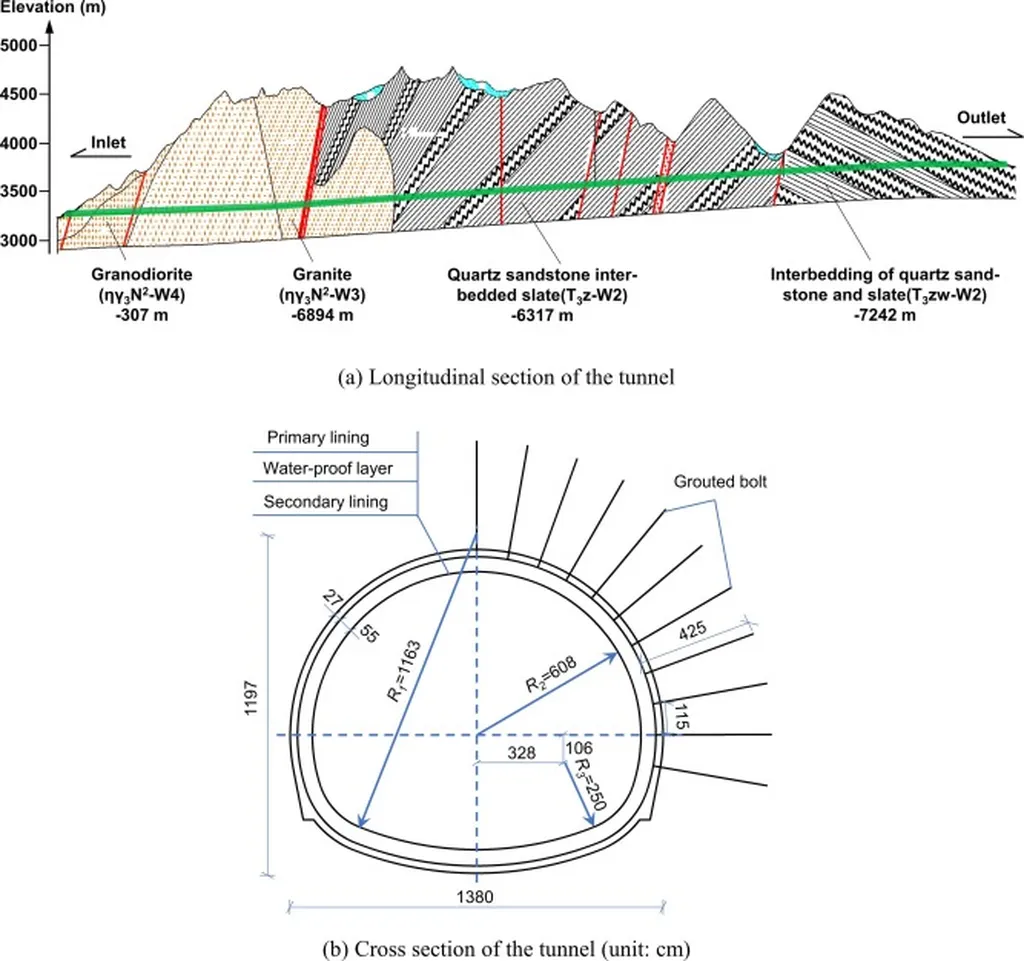
In the heart of China’s Sichuan province, a team of researchers from Southwest Jiaotong University has developed a groundbreaking model that could revolutionize the way we build and test tunnels, particularly those crossing fault lines. Led by ZHOU Pengfa, the team has created a dynamic model container with hinged sidewalls, designed to simulate the seismic activity that tunnels might encounter, especially in high-intensity seismic zones.
The model, detailed in a recent paper published in ‘Yantu gongcheng xuebao’ (translated to English as ‘Rock and Soil Mechanics’), is a significant step forward in anti-seismic testing technology. It’s not just about understanding how tunnels behave during earthquakes, but also about ensuring the safety and longevity of these structures, which are crucial for transportation and energy infrastructure.
The team’s model container is equipped with hinged sidewalls and springs, mimicking the behavior of soils and fault interfaces. By adjusting the stiffness of these springs, the researchers can control the boundary effects, ensuring that the model accurately represents real-world conditions. “The stiffness of boundary springs should be determined based on the minimum 2-norm deviation between the model soil response and the free-field soil response, following the principle of ‘flexible but not rigid’,” explains ZHOU Pengfa, the lead author of the study.
The implications for the energy sector are substantial. Pipelines and tunnels are vital for transporting oil, gas, and other resources. Ensuring their safety during seismic events is not just a matter of structural integrity, but also of environmental protection and economic stability. The team’s research provides a valuable reference for shaking table tests in underground engineering, helping to determine the impact range of fault interfaces on tunnel structures.
The findings of the study indicate that the model system can effectively reproduce the zonal impact characteristics of tunnels near fault interfaces. This means that engineers can now better predict how tunnels will behave during earthquakes, allowing for more robust and resilient designs. “The results of the shaking table tests indicate that the model system can well reproduce the zonal impact characteristics of the tunnel near the fault interface,” says ZHOU.
As the world grapples with the challenges of climate change and the need for sustainable energy solutions, the role of tunnels and pipelines in transporting resources becomes even more critical. The research conducted by ZHOU Pengfa and his team at Southwest Jiaotong University is a testament to the power of innovation in addressing these challenges. By providing a more accurate and reliable method for testing the seismic performance of tunnels, they are helping to pave the way for a safer and more sustainable future.
This research not only enriches the seismic testing technology for tunnels in high-intensity seismic zones but also sets a new standard for underground engineering. As we move forward, the insights gained from this study will undoubtedly shape the future of tunnel engineering, ensuring that our infrastructure is resilient, safe, and capable of withstanding the forces of nature.