
In the bustling coastal city of Taizhou, where the soft soil beneath the surface presents unique challenges for underground construction, a team of researchers has made significant strides in improving the accuracy of deformation predictions. Led by CHEN Jun of the Institute of Geology and Mineral Exploration Zhejiang, the team has employed the Hardening Soil Small (HSS) model to simulate the behavior of soft soils during excavation projects. Their findings, published in the journal *Yantu gongcheng xuebao* (Chinese Journal of Geotechnical Engineering), offer promising insights for the energy sector and other industries involved in underground infrastructure development.
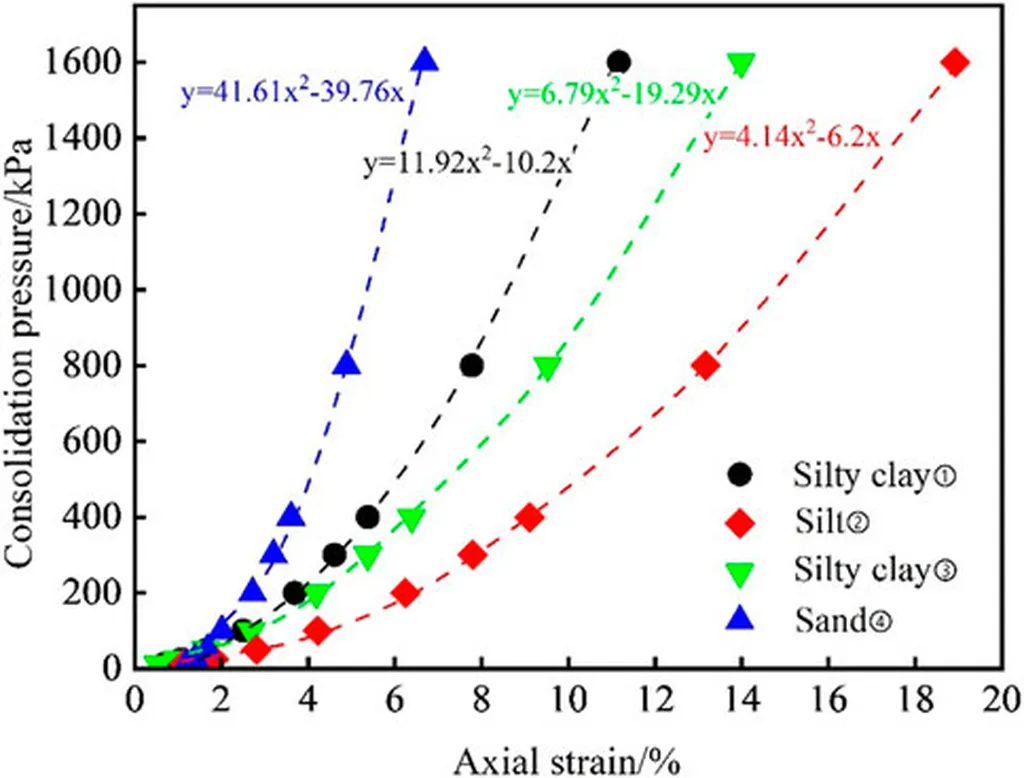
The HSS model, known for its ability to account for the nonlinear response characteristics of soils within small strain ranges, has been calibrated using a series of laboratory tests and empirical equations. This calibration process is crucial for obtaining accurate predictions of surface settlement and structural deformation. As CHEN Jun explains, “The HSS model provides a more precise simulation of soil behavior compared to other models, which is essential for ensuring the safety and stability of underground structures.”
The team applied these calibrated parameters to a real-world excavation project, simulating it in 3D Finite Element Method (FEM) and comparing it with a model using parameters from a geotechnical report. The results were compelling: the parameters derived from laboratory tests closely matched the measured values for horizontal deformation, validating the accuracy of the calibration method.
For the energy sector, these findings are particularly significant. Underground infrastructure, such as pipelines and storage facilities, often requires excavation in soft soil areas. Accurate predictions of deformation can prevent costly mistakes and ensure the longevity of these structures. As SUN Feng of the Hangzhou Metro Group Corporation Limited notes, “Understanding the behavior of soft soils is critical for the energy sector, where the integrity of underground infrastructure is paramount.”
The research also highlights the importance of laboratory testing in calibrating geotechnical models. By refining the parameters of the HSS model, the team has demonstrated a method that can be applied to other soft soil areas, potentially revolutionizing the way underground projects are planned and executed.
Looking ahead, this study paves the way for future developments in the field of geotechnical engineering. As the demand for underground infrastructure continues to grow, the need for accurate and reliable models becomes ever more pressing. The work of CHEN Jun and his team not only advances our understanding of soft soil behavior but also sets a new standard for the industry.
In the words of ZHUANG Xingyue, also from the Institute of Geology and Mineral Exploration Zhejiang, “This research provides valuable insights for predicting deformation in underground projects, particularly in coastal areas where soft soils are prevalent.” With these insights, the energy sector and other industries can look forward to more efficient and safer underground construction practices.