
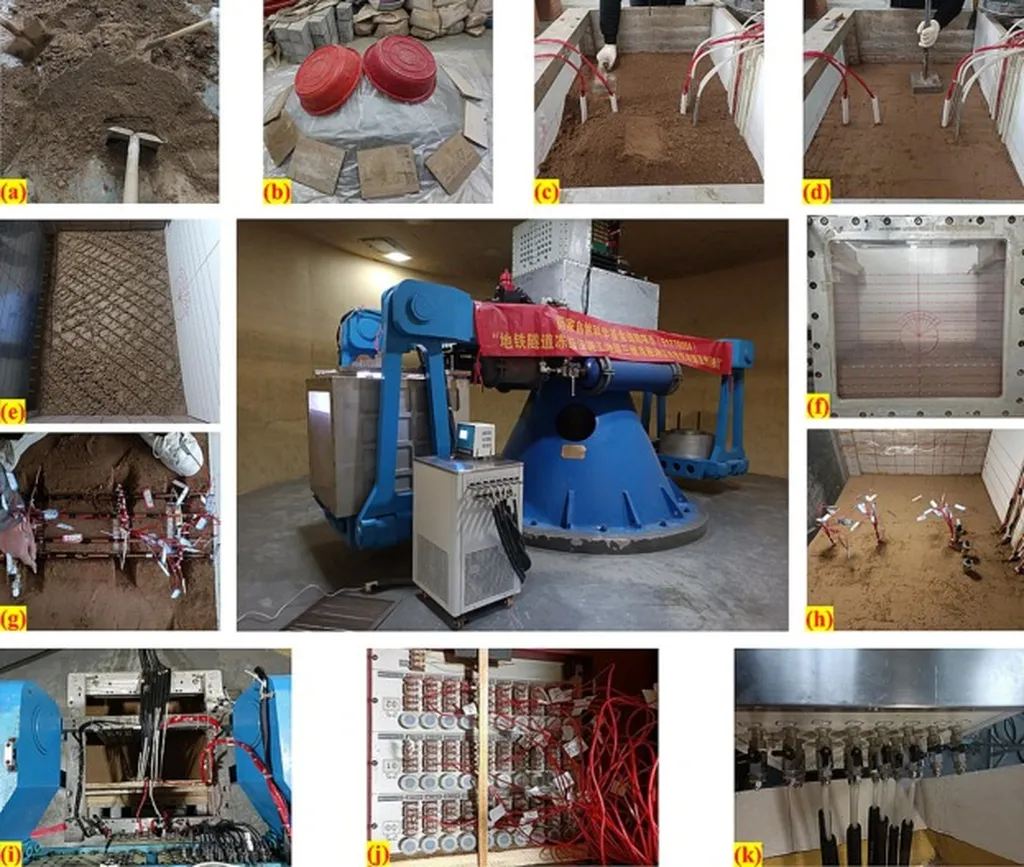
In the heart of Shanghai, researchers at Tongji University have developed a groundbreaking piece of equipment that could significantly impact the energy sector’s approach to frozen soil engineering. The team, led by Dr. Zhou Jie from the College of Civil Engineering, has designed a novel centrifugal model test equipment that promises to revolutionize the way we understand and work with frozen soil.
The challenge with existing centrifugal model test devices is that they can only control the temperature boundary, not form a continuous freezing wall in the soil body. This limitation hampers the ability to accurately simulate and study the freezing process of tubular cold sources in soil, a critical aspect of artificial formation freezing. Dr. Zhou and his team have tackled this issue head-on, creating a device that uses both semiconductor refrigeration and controlled liquid nitrogen freezing.
The equipment, designed to work with the TJ-150 geotechnical centrifuge, allows for precise control of the boundary temperature of the freezing wall. Simultaneously, the liquid nitrogen freezing devices ensure stable storage and fixed-point transportation of liquid nitrogen. This dual approach enables researchers to simulate the freezing process more accurately than ever before.
The implications for the energy sector are substantial. Understanding the permeability coefficient of soft soil before and after freeze-thaw is crucial for various applications, including the construction of pipelines and the development of underground storage facilities. Dr. Zhou explained, “Our equipment allows us to explore the change rules of the permeability coefficient of soft soil before and after freeze-thaw, providing valuable data for the energy sector.”
The team conducted a centrifuge micro-pore pressure static penetration test to demonstrate the equipment’s capabilities. The performance was tested under 15g centrifugal super-gravity, and the results were promising. Dr. Zhou noted, “The feasibility of measuring the permeability coefficient of soft clay before and after freeze-thaw using our centrifuge micro-pore pressure static penetration test devices has been preliminarily explored.”
This research, published in the Chinese journal ‘Yantu gongcheng xuebao’ (translated to ‘Rock and Soil Mechanics’), marks a significant step forward in frozen soil engineering. The ability to accurately simulate and study the freezing process will not only enhance our understanding of soil behavior but also pave the way for more efficient and effective engineering solutions in the energy sector.
As the world continues to push the boundaries of what’s possible, innovations like this one from Tongji University will play a crucial role in shaping the future of construction and energy development. The research team’s work is a testament to the power of innovation and the potential it holds to transform industries and improve our understanding of the world around us.