
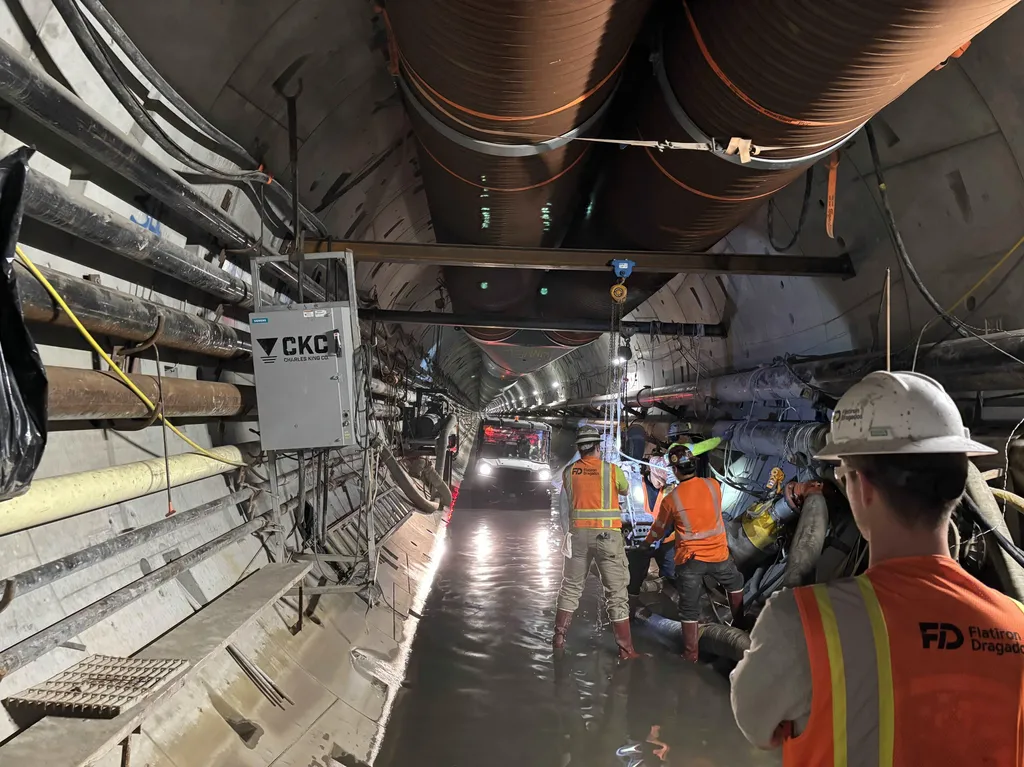
In the intricate world of underground construction, managing water seepage is a critical challenge that can significantly impact the safety and longevity of tunnels. A recent study published in *Yantu gongcheng xuebao* (translated as *Rock and Soil Mechanics*) offers a groundbreaking analytical solution for understanding the transient seepage fields in twin shallow-buried parallel relief tunnels. This research, led by Dr. Huang Yue from the Urban Construction Center of Lucheng District in Wenzhou, China, in collaboration with researchers from Zhejiang University, Central South University, and Sun Yat-sen University, promises to revolutionize the way engineers approach seepage management in complex underground projects.
Seepage is a pervasive issue in tunnel construction, particularly in shallow-buried tunnels where the interaction between adjacent tunnels can exacerbate the problem. “The excavation of tunnels induces transient seepage fields that mutually interact with those of adjacent pressure relief tunnels,” explains Dr. Huang. “Understanding this interaction is crucial for ensuring the safety and efficiency of tunnel construction and operation.”
The research team developed a two-dimensional plane strain analytical model to address the transient seepage coupling mechanism in twin shallow-buried parallel tunnels. For a single shallow circular tunnel, they mapped the semi-infinite seepage domain to an annular region using conformal transformation. By integrating the superposition principle and variable separation method, they derived the transient seepage fields. The Schwarz iteration method was then employed to construct an iterative algorithm for dual tunnel transient seepage coupling, achieving temporal superposition through dynamic boundary coupling and spatiotemporal discretization.
The implications of this research are far-reaching, particularly for the energy sector, where underground construction is a cornerstone of infrastructure development. “This analytical framework provides a theoretical basis for deciphering the transient seepage interactions in tunnel clusters under complex geological conditions,” says Dr. Jiang An, a co-author from Zhejiang University. “It offers critical insights for seepage risk mitigation in deep underground engineering, which is essential for the safe and efficient operation of energy-related infrastructure.”
The study’s findings have been validated against numerical simulations and published data, confirming the accuracy and computational efficiency of the solution. This validation is a testament to the robustness of the analytical model, which can be applied to a wide range of underground construction projects.
As the energy sector continues to expand, the need for safe and efficient underground construction becomes increasingly paramount. The research led by Dr. Huang and his team provides a valuable tool for engineers and construction professionals, enabling them to better manage seepage risks and ensure the integrity of their projects. “This research is a significant step forward in our understanding of transient seepage fields in twin tunnels,” says Dr. Yu Jun, a co-author from Central South University. “It will undoubtedly shape future developments in the field and contribute to the advancement of underground construction technologies.”
In conclusion, the study published in *Yantu gongcheng xuebao* represents a major advancement in the field of underground construction. By providing a comprehensive analytical solution for transient seepage fields in twin shallow-buried parallel tunnels, the research offers a powerful tool for managing seepage risks and ensuring the safety and efficiency of underground projects. As the energy sector continues to grow, the insights gained from this research will be invaluable for engineers and construction professionals working on complex underground infrastructure projects.