
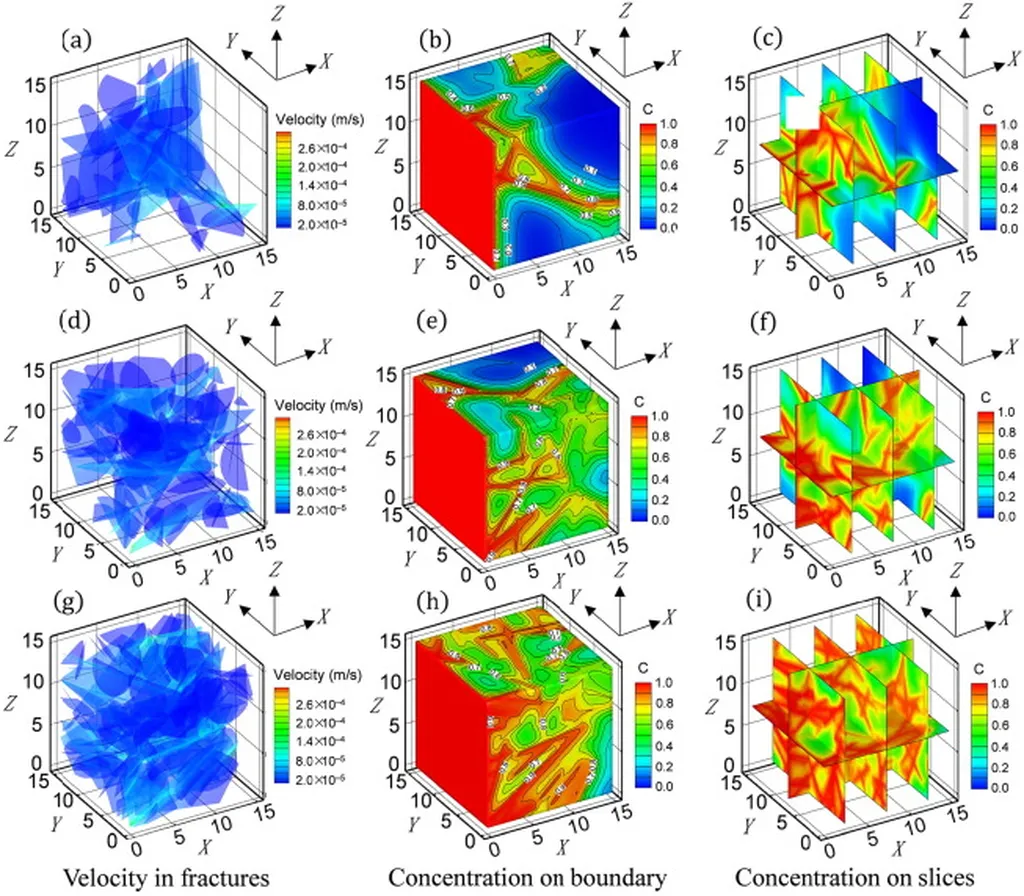
In the intricate world of fractured rocks, understanding how pollutants or resources move through the subsurface has long been a puzzle for scientists and engineers alike. A recent study published in *Yantu gongcheng xuebao* (Chinese Journal of Geotechnical Engineering) by NAI Yu’ao and colleagues from Wuhan University and China University of Geosciences has cracked open new possibilities for predicting solute transport in these complex environments. The research, led by NAI Yu’ao, delves into the geometric parameters of fracture networks, offering a breakthrough that could revolutionize how we approach subsurface pollution remediation, resource extraction, and geohazard monitoring.
The study simulates solute transport processes under various geometric characteristics of fracture networks, analyzing the quantitative control mechanisms of fracture density, discreteness, and mean fracture aperture. “The fracture density and mean aperture are the decisive factors in controlling solute transport,” explains NAI Yu’ao, “while the influences of the fracture distribution discreteness depend on the connectivity of pathways formed by specific fracture networks.” This finding is a game-changer, as it provides a clear, quantifiable way to understand and predict how solutes move through fractured rocks.
The researchers developed parameterization formulas for key transport coefficients, the hydrodynamic dispersion coefficient (D) and solute transport velocity (Vt), using dimensionless fracture density and mean aperture. These formulas were then incorporated into the classical macroscopic advection–dispersion analytical solution to establish a predictive model for solute transport processes based on the geometric parameters of the fracture network. The model’s accuracy and reliability were validated through comparisons with numerical results under various conditions.
For the energy sector, the implications are profound. Efficient underground resource extraction, such as oil, gas, and geothermal energy, relies heavily on understanding solute transport. “This model enables high-fidelity prediction of solute transport processes using only the geometric parameters of the fracture network and hydrodynamic conditions,” says ZHOU Jiaqing, a co-author of the study. This means lower costs and more efficient predictions, which can significantly impact the profitability and sustainability of underground resource exploitation.
Moreover, the study’s findings have significant theoretical implications for rapid assessments of subsurface pollution and efficient underground resource exploitation. The quantitative control mechanisms of fracture network geometry on solute transport established in this research provide a theoretical basis for studying the coupling between the structural evolution of rock mass and hydrochemical signals. This could lead to advancements in tracing rock failure states and early warning systems for geohazards, further enhancing safety and efficiency in the energy sector.
The research published in *Yantu gongcheng xuebao* (translated to English as “Chinese Journal of Geotechnical Engineering”) opens new avenues for future developments in the field. As we continue to push the boundaries of our understanding of subsurface processes, this study serves as a beacon, guiding us toward more accurate, efficient, and cost-effective solutions for the challenges we face in the energy sector and beyond.