
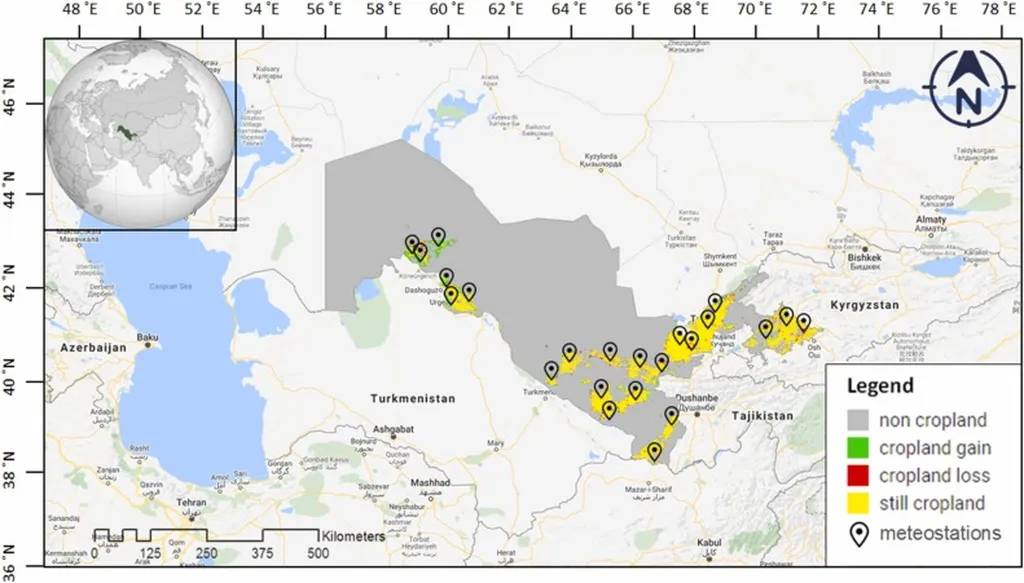
In the vast, arid landscapes of Uzbekistan, where temperatures swing wildly between day and night, a critical challenge looms for infrastructure developers: the stability of roads built on saline soil. As China’s “One Belt and One Road” initiative drives a surge in transportation projects across Central Asia, a team of researchers from the School of Civil Engineering at Xi’an University of Architecture and Technology has uncovered crucial insights into the behavior of saline soil under extreme temperature fluctuations.
Led by Dr. Zheng Fang and Professor Song Zhanping, the team investigated the impact of freeze-thaw cycles and varying salt content on the mechanical properties of saline soil and the stability of subgrade slopes. Their findings, published in the journal *Yantu gongcheng xuebao* (translated to English as “Rock and Soil Engineering”), offer a roadmap for more resilient infrastructure development in challenging environments.
The researchers subjected saline soil samples to repeated freeze-thaw cycles, mimicking the extreme temperature differences common in Uzbekistan. Through unconsolidated undrained triaxial shear tests, they observed that as salt content increased, the soil’s failure strength decreased linearly, while cohesion and internal friction angle exhibited a quadratic decline. “This means that higher salt concentrations make the soil more prone to failure under load,” explained Dr. Zheng Fang.
The study also revealed that with each freeze-thaw cycle, the soil’s failure strength and cohesion continued to diminish, following a logarithmic decay pattern. Conversely, the internal friction angle increased logarithmically. These changes significantly impact the safety factor of roadbed slopes, which decreases as both salt content and the number of freeze-thaw cycles rise.
For the energy sector, these findings are particularly relevant. Many oil and gas pipelines and transportation routes traverse similar terrains, where soil stability is paramount. “Understanding these patterns allows engineers to design more robust infrastructure that can withstand the test of time and temperature,” said Professor Song Zhanping.
The research underscores the need for careful consideration of soil composition and environmental conditions in infrastructure projects. By incorporating these insights, developers can mitigate risks and enhance the longevity of their investments. As the world continues to push the boundaries of construction in extreme environments, this study serves as a vital guide for future developments, ensuring that the roads and energy corridors of tomorrow are built on a solid foundation.