
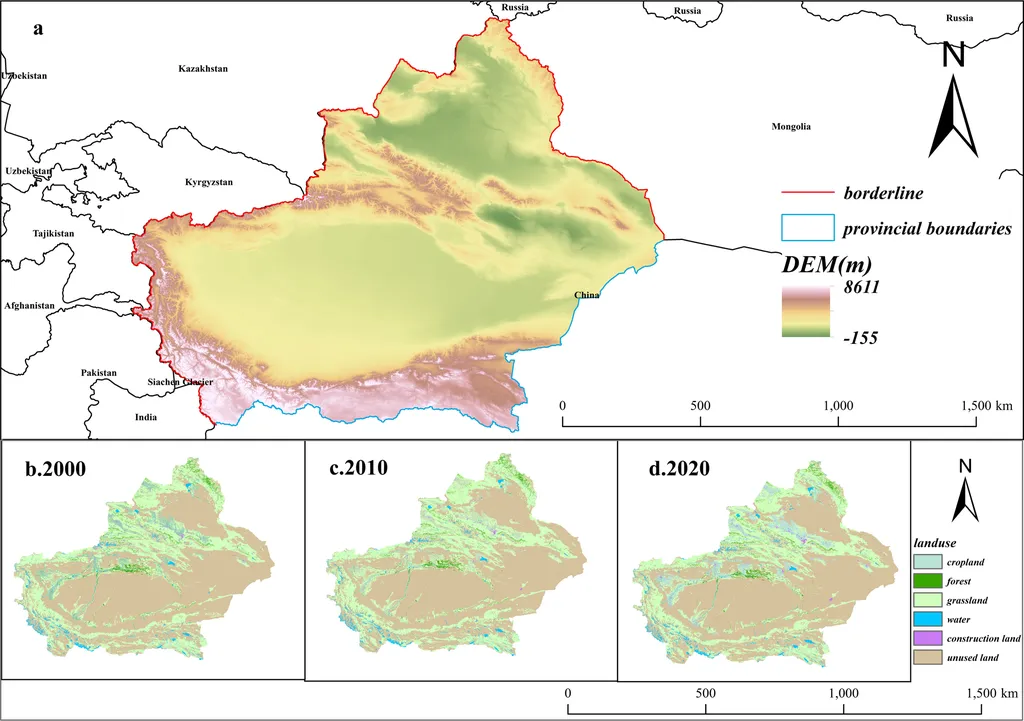
In the vast, arid landscapes of northern Xinjiang, a unique challenge lies beneath the surface: salinized silty soil, a material that poses significant risks to infrastructure stability, particularly in the energy sector. A recent study published in *Yantu gongcheng xuebao* (translated to *Rock and Soil Mechanics*) sheds light on the deformation characteristics of this soil, offering crucial insights for engineers and developers.
Led by ZHANG Chen of the Geotechnical Engineering Department at Nanjing Hydraulic Research Institute, the research team conducted comprehensive compression and humidification deformation tests on salinized silty soil samples. Their findings reveal that the compression characteristics of this soil are less influenced by dry density but significantly affected by water and salt content. “When the water content is at 7.8%, the compressive modulus is remarkably high at 46.10 MPa,” explains ZHANG. “However, this drops dramatically to 9.75 MPa when the sample is saturated.”
The study also highlights the impact of salt content on soil deformation. “Under low perimeter pressure, the change in salt content significantly affects the moisture-enhancing deformation,” notes ZHANG. Interestingly, the presence of sulfate promotes soil swelling, but when the consolidation load exceeds 25 kPa, increased salt content suppresses swelling and can even lead to compression deformation.
These findings have profound implications for the energy sector, particularly for dam construction and maintenance in northern Xinjiang. Understanding the deformation characteristics of salinized silty soil can help engineers design more stable and durable structures, reducing the risk of failures and extending the lifespan of critical infrastructure.
The research also underscores the importance of correlation analysis in geotechnical engineering. By identifying the primary influencing factors—water content for compression characteristics and salt content for humidification and deformation—engineers can make more informed decisions during the planning and construction phases.
As the energy sector continues to expand into challenging environments, studies like this one become increasingly vital. “Our goal is to provide practical insights that can be directly applied to real-world projects,” says ZHANG. By doing so, they are not only advancing scientific knowledge but also contributing to the safety and efficiency of energy infrastructure.
This research, published in *Yantu gongcheng xuebao*, serves as a testament to the power of interdisciplinary collaboration and the critical role of geotechnical engineering in shaping the future of the energy sector. As engineers and developers continue to push the boundaries of what is possible, studies like this one will be instrumental in ensuring the stability and sustainability of our infrastructure.