
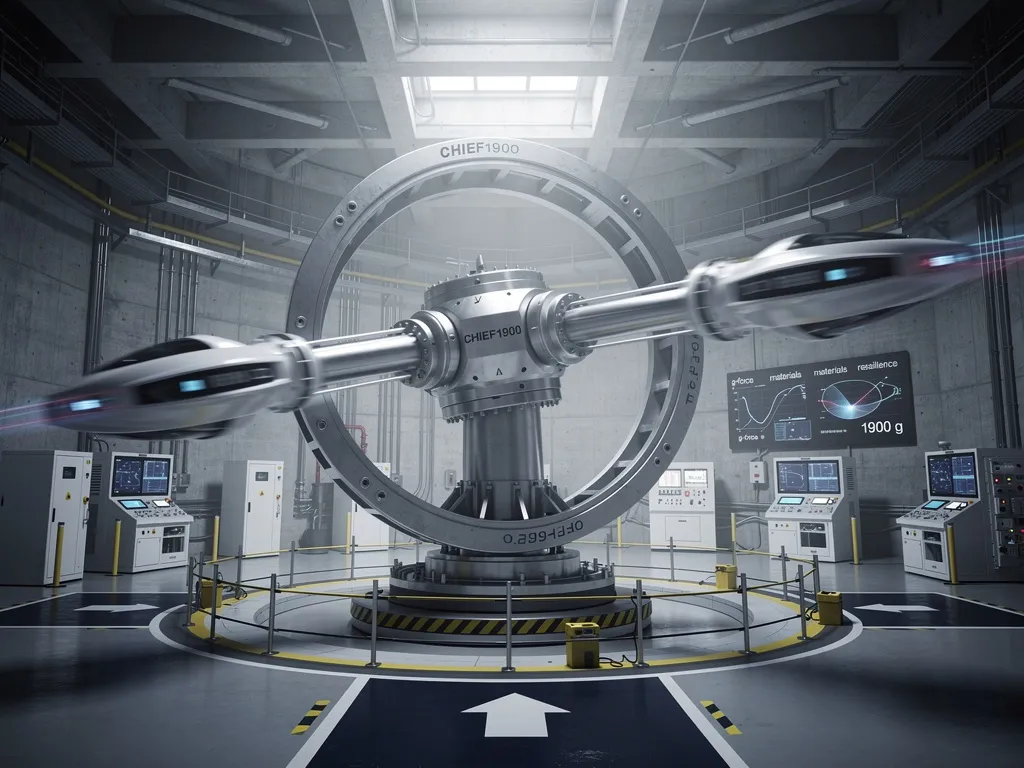
In the heart of Hangzhou, China, researchers at Zhejiang University are pushing the boundaries of geotechnical engineering, with implications that could ripple through the energy sector. Led by Dr. Daosheng Ling from the Institute of Geotechnical Engineering and the Center for Hypergravity Experimental and Interdisciplinary Research, a team has been exploring the behavior of objects in centrifugal hypergravity fields and refining rainfall simulation techniques. Their work, published in *Yantu gongcheng xuebao* (translated as *Rock and Soil Mechanics*), could revolutionize how we approach slope stability and erosion control in energy infrastructure projects.
The team’s innovative use of centrifuges—devices that simulate high-gravity environments—to study the motion of unconstrained spheres has yielded groundbreaking insights. By employing binocular stereo vision to reconstruct the spheres’ trajectories, they’ve validated and refined equations governing particle motion in these extreme conditions. “The coupling of mass changes and the non-inertial frame creates an additional force acting on the object,” explains Dr. Ling. “Understanding this force is crucial for predicting the behavior of materials in high-gravity environments, such as those encountered in deep-sea or high-altitude energy projects.”
But the implications don’t stop at particle motion. The researchers have also turned their attention to rainfall simulation, a critical factor in assessing slope stability and erosion control. By analyzing the spatial and statistical distribution of rainfall from the Green Mist nozzle, they’ve proposed four new rainfall uniformity indexes. These indexes could guide the optimal layout of nozzle arrays, ensuring more accurate and reliable erosion testing.
For the energy sector, these advancements could be a game-changer. “Imagine being able to predict with greater accuracy how rainfall will affect the stability of slopes in mining operations or the integrity of pipelines in harsh environments,” says Dr. Ling. “Our research brings us one step closer to that reality.”
The team’s findings suggest that the overlap of nozzle coverage area along the length and width directions of a side slope should be around 60.47% and 55.36%, respectively, for a 2×2 Green Mist nozzle array. While these values are specific to their experimental setup, the underlying principles could be adapted to a wide range of scenarios.
As the energy sector continues to expand into more challenging environments, the need for accurate, reliable testing methods grows ever more pressing. The work of Dr. Ling and his team at Zhejiang University is not just about advancing geotechnical engineering; it’s about providing the energy sector with the tools it needs to operate safely and sustainably in an increasingly complex world. Their research serves as a reminder that even in the most established fields, there’s always room for innovation—and that the pursuit of knowledge can have far-reaching, real-world impacts.