
In a groundbreaking development that could revolutionize the energy sector, researchers have successfully combined electrospinning and electrospraying techniques to create advanced polymer mats embedded with single-walled carbon nanotubes (SWCNTs). This innovative approach, detailed in a recent study published in ‘Macromolecular Materials and Engineering’ (which translates to ‘Macromolecular Engineering Materials’), opens new avenues for thermoelectric and gas sensing applications.
Dr. Beate Krause, lead author of the study from the Leibniz-Institut für Polymerforschung Dresden e.V. in Dresden, Germany, and her team employed a one-step procedure to produce fiber mats using a blend of poly(vinylidene fluoride) (PVDF) and thermoplastic polyurethane (TPU), as well as polylactide (PLA), coated with SWCNTs. The resulting mats exhibit remarkable thermoelectric properties and gas sensing capabilities, making them highly relevant for energy and environmental monitoring applications.
The thermoelectric investigation of these mats revealed Seebeck coefficients ranging from 21 to 27 µV·K−1, which were found to be nearly independent of the SWCNT content and the type of polymer used. “The thermoelectric properties of the SWCNTs are primarily influenced by the n-type doping effect of the solvents and additives used in the electrospraying process,” explained Dr. Krause. “The polymer nanofibers serve mainly as a porous mechanical support, providing structural integrity to the mats.”
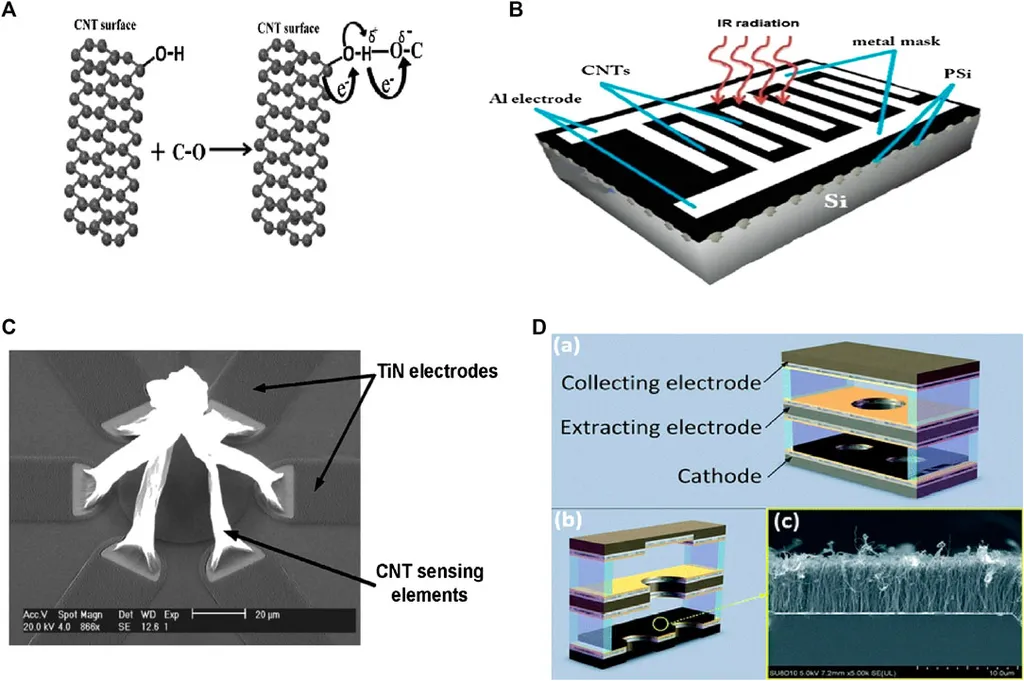
One of the most compelling aspects of this research is the potential for these mats to be used in gas sensing applications. The study demonstrated that mats containing just 0.25 wt% SWCNTs showed a significant sensor response when exposed to saturated acetone vapor. “The sensing mechanism is driven by interactions between the solvent molecules and the SWCNTs, rather than by interactions with the polymer matrix,” noted Dr. Krause. This finding suggests that the mats could be highly effective in detecting and monitoring various gases, a capability that could be crucial for safety and environmental applications.
The research also highlighted that the PLA-based mats exhibited better sensor recovery compared to the PVDF-based ones. In cyclic tests with short exposure times, both types of mats showed highly stable and reproducible sensing behavior, indicating their potential for long-term use in demanding environments.
The implications of this research for the energy sector are profound. Thermoelectric materials that can convert waste heat into electricity are highly sought after for improving energy efficiency in various industrial processes. Additionally, advanced gas sensing technologies are essential for monitoring and controlling emissions, ensuring workplace safety, and detecting leaks in energy infrastructure.
As Dr. Krause and her team continue to explore the potential of these advanced materials, the energy sector can look forward to innovative solutions that enhance efficiency, safety, and sustainability. The study published in ‘Macromolecular Materials and Engineering’ marks a significant step forward in the development of multifunctional materials that could shape the future of energy and environmental technologies.