
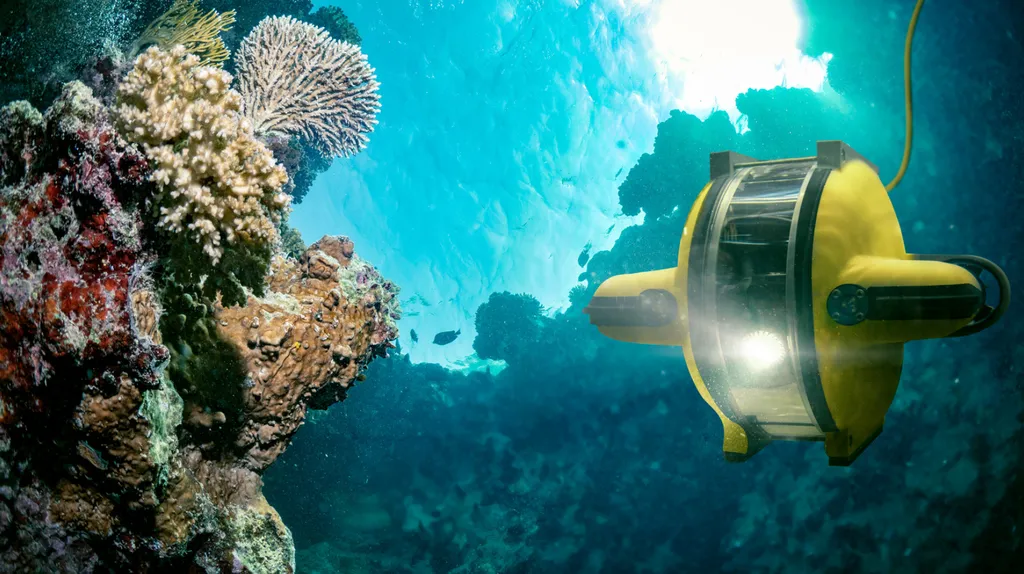
In the abyssal depths of the ocean, where pressures can reach crushing extremes, a team of researchers has drawn inspiration from nature to develop a groundbreaking tactile sensor that could revolutionize underwater robotic operations. Led by Qingyang Zheng from the State Key Laboratory of Intelligent Manufacturing Equipment and Technology at Huazhong University of Science and Technology, the team has created a bioinspired deep-sea iontronic skin that promises to enhance the capabilities of underwater robots, particularly in the energy sector.
The challenge of detecting delicate contact forces in the face of immense hydrostatic pressures has long hindered the advancement of underwater tactile sensing technology. “Detecting hundred-pascal-level contact forces under tens-of-megapascal hydrostatic pressures is a critical challenge,” Zheng explains. To overcome this, the researchers turned to the deep-sea sponge, an organism that has evolved to thrive in high-pressure environments.
The innovative sensor features a fully open-pore hydrophobic ionogel as its sensing layer, mimicking the sponge’s hydrostatic skeletal supporting mechanisms. This design allows the sensor to convert contact forces into electrical signals, enabling objects to be classified and manipulated with precision. “The sensor maintains stable contact force detection under 50 MPa hydrostatic pressure,” Zheng notes, highlighting its robustness.
The implications for the energy sector are significant. Underwater robots equipped with this tactile sensing technology could greatly enhance the exploration and exploitation of deep-sea resources. From oil and gas extraction to the maintenance of offshore wind farms, the ability to perform non-destructive operations with human-like sensory capabilities is a game-changer. The sensor’s aquatic stability and its ability to balance internal and external hydrostatic pressures reduce environmental disturbances, ensuring accurate and reliable performance.
The research, published in the journal *npj Flexible Electronics* (translated from Chinese as “Flexible Electronics”), demonstrates an overall recognition accuracy of 95.5% in classifying objects of varying hardness. This level of precision opens up new possibilities for sustainable resource exploitation and environmental monitoring.
As the world looks to the oceans for future energy solutions, this bioinspired technology could play a pivotal role in shaping the future of underwater robotics. By mimicking nature’s own solutions, the researchers have not only advanced the field of tactile sensing but also brought us one step closer to harnessing the vast resources of the deep sea in a sustainable and efficient manner.