
In the realm of robotics, a new player has emerged that could revolutionize the way we think about mobility and adaptability in machines. Researchers, led by Z. Wei from the School of Automation at Nanjing University of Information Science & Technology, have introduced DTransleg, a transformable leg-wheel robot designed to tackle the complexities of existing articulated-leg robots. This innovation, detailed in a recent study published in *Mechanical Sciences* (which translates to *Mechanical Science* in English), promises to bring a new level of agility and stability to robotic systems, with significant implications for the energy sector and beyond.
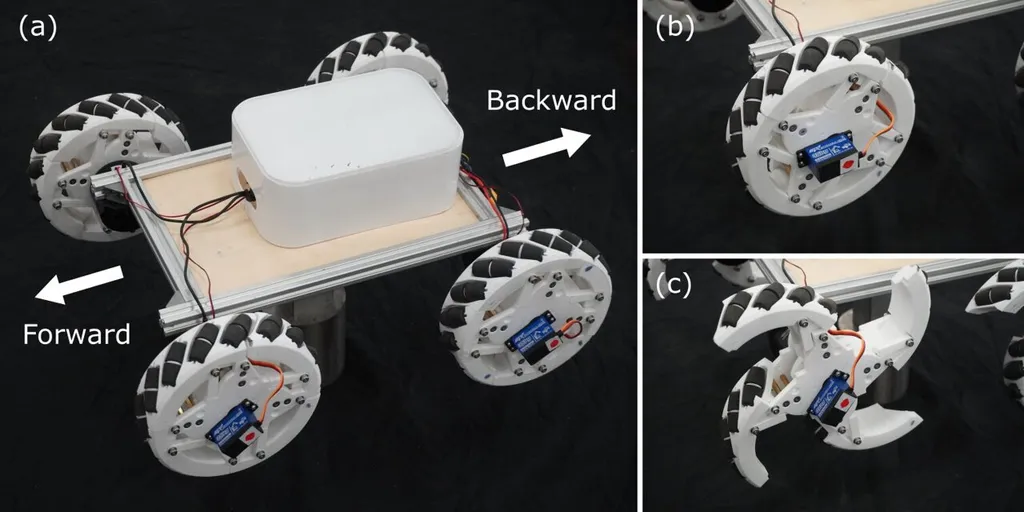
The DTransleg robot stands out due to its unique design, which allows it to seamlessly switch between wheel mode and articulated-leg mode. This versatility is achieved through four identical leg-wheel mechanisms, each capable of transforming to meet different terrain and task requirements. “The key innovation here is the elimination of additional actuators by designing the thigh segment as a circular rim,” explains Wei. This design choice not only simplifies the structure but also enhances the robot’s efficiency and maneuverability.
In wheel mode, the robot operates with a single active joint, driven by the hip-pitch actuator, making it ideal for smooth, flat surfaces. Transitioning to leg mode unlocks three active joints per mechanism, providing the robot with the agility to navigate rough and uneven terrain. The incorporation of waist yaw and pitch joints further enhances the robot’s stability and adaptability, making it a formidable tool for various applications.
The research paper delves into the design methodology, kinematic modeling, and motion planning for the robot’s four-wheeled, quadruped, and carriage modes, along with the strategies for transitioning between these modes. Both simulations and physical experiments have validated the feasibility of the design and the accuracy of the modeling and motion planning.
The potential commercial impacts of this research are vast, particularly in the energy sector. Imagine robots that can effortlessly transition from smooth factory floors to rugged offshore platforms, or from urban environments to remote, uneven terrains for inspection and maintenance tasks. The DTransleg’s ability to adapt to different environments could significantly enhance the efficiency and safety of operations in the energy sector, reducing the need for human intervention in hazardous conditions.
This innovation also opens up new avenues for research and development in the field of robotics. The ability to seamlessly integrate leg and wheel mechanisms could inspire future designs that push the boundaries of what robots can achieve. As Wei notes, “The transformable nature of DTransleg not only enhances its versatility but also paves the way for more adaptable and resilient robotic systems in the future.”
In conclusion, the DTransleg robot represents a significant step forward in the field of robotics, offering a versatile and adaptable solution that could transform various industries. With its innovative design and proven capabilities, it sets a new standard for robotic mobility and adaptability, promising a future where robots can seamlessly navigate and operate in diverse environments.