
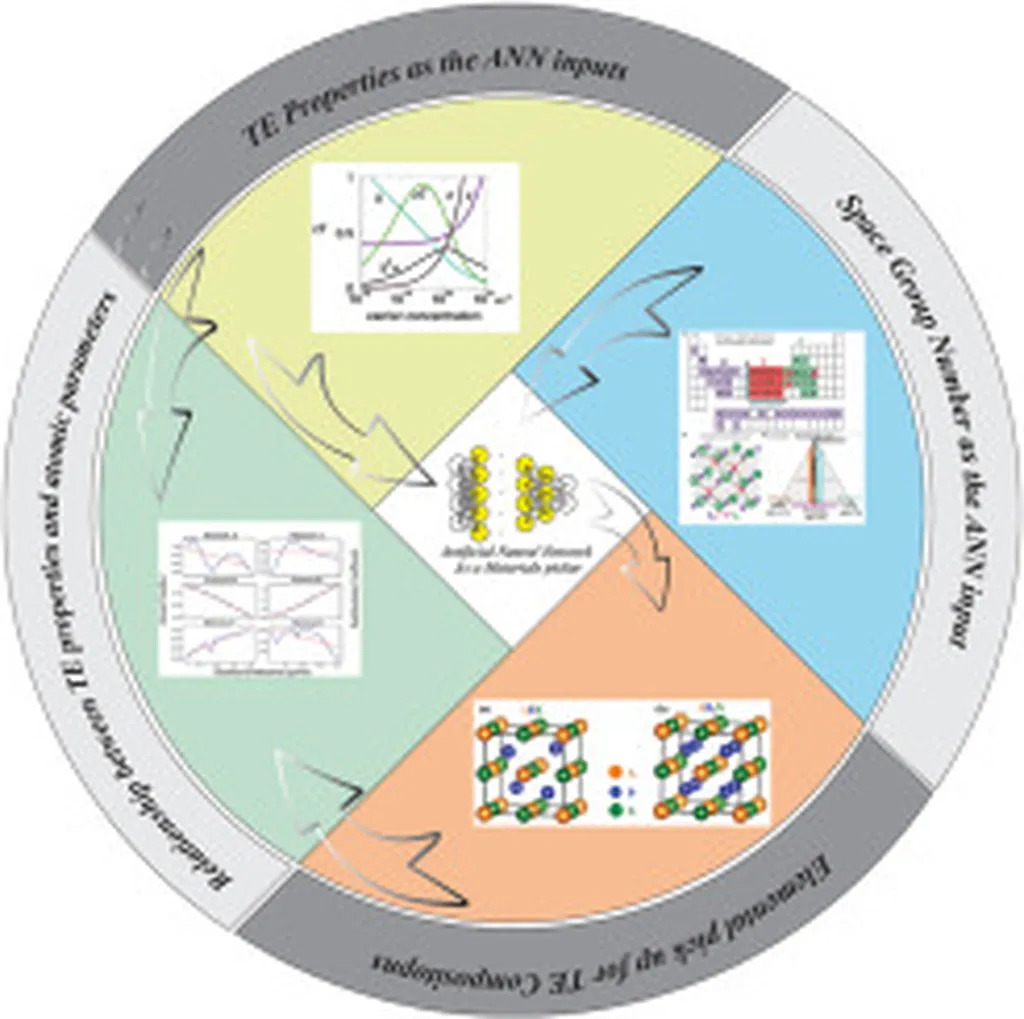
In the quest for high-efficiency energy conversion materials, a groundbreaking study led by Kadhum Hassan Ali from the College of Mechanical Engineering at the University of Technology in Iraq, has introduced a novel data-driven approach that could revolutionize the field of thermoelectric materials. Published in Discover Materials, which translates to “Kashf Al-Mawad” in English, the research leverages the power of artificial intelligence to predict thermoelectric properties with remarkable accuracy.
Thermoelectric materials, which convert heat into electricity, hold immense potential for the energy sector. They can harness waste heat from industrial processes, vehicles, and even electronic devices, contributing to a more sustainable energy landscape. However, the design and discovery of high-performance thermoelectric materials have been challenging due to the complex interplay of various factors.
Enter DeepELM-DNNs, a sophisticated model developed by Ali and his team. This model, based on extremely learned Deep Neural Networks, is designed to forecast the power factor, a crucial indicator of thermoelectric performance. The team tested three DeepELM-DNN models using experimentally collected data on the Seebeck coefficient, electrical resistivity, and temperature for two polycrystalline systems: (GeTe)₁₀Sb₂Te₃ and (GeTe)₂₄Sb₂Te₃.
The results were impressive. The best-performing model, DeepELM-DNN-3, achieved exceptional accuracy, with a Mean Absolute Error (MAE) as low as 0.0932 and a Coefficient of Determination (R²) of 0.9837 for (GeTe)₁₀Sb₂Te₃. For (GeTe)₂₄Sb₂Te₃, the model also performed robustly, with an MAE of 0.1032 and an R² of 0.9834. These metrics underscore the model’s ability to capture the nonlinear relationships between temperature, composition, and thermoelectric performance.
“The robustness of the DeepELM-DNN model in describing zT magnitudes, which is a dimensionless figure of merit for thermoelectric materials, opens up new avenues for the rational design of high-efficiency energy conversion materials,” Ali explained. This breakthrough could significantly accelerate the discovery of advanced thermoelectric materials, reducing the time and cost associated with traditional trial-and-error methods.
The implications for the energy sector are profound. By enabling the rapid and accurate prediction of thermoelectric properties, this AI-driven approach could expedite the development of materials that can efficiently convert waste heat into electricity. This, in turn, could enhance energy efficiency in various industries, reduce greenhouse gas emissions, and contribute to a more sustainable energy future.
As the world grapples with the challenges of climate change and energy sustainability, innovations like the DeepELM-DNN model offer a glimmer of hope. By harnessing the power of artificial intelligence, researchers are paving the way for a new era of materials science, one that promises to transform the energy landscape and drive us towards a cleaner, greener future.
In the words of Ali, “The potential of AI-driven discovery in the field of thermoelectric materials is immense. This research is just the beginning, and we are excited about the possibilities that lie ahead.”