
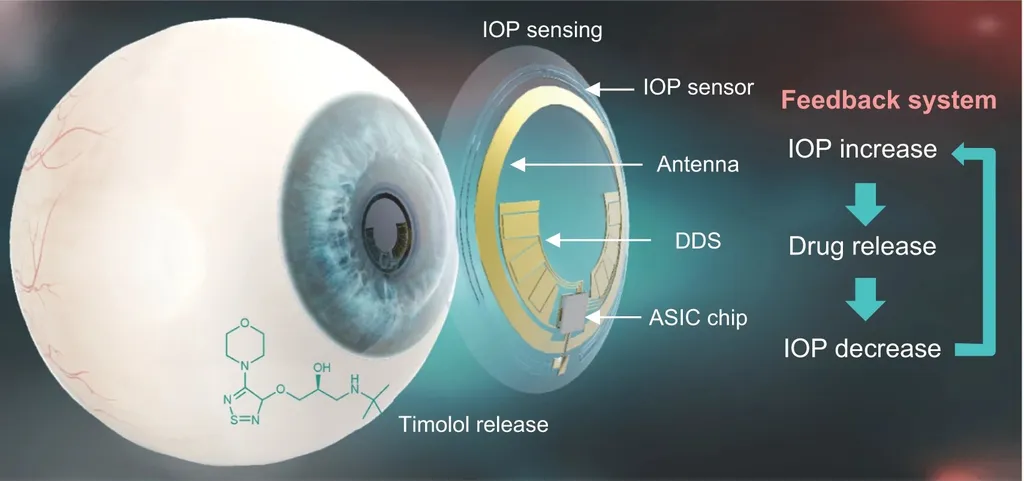
In a groundbreaking development that could revolutionize the way we monitor and manage eye health, researchers have unveiled a smart contact lens capable of ultra-sensitive, real-time monitoring of intraocular pressure (IOP). This innovation, published in the journal *npj Flexible Electronics* (translated as “Flexible Electronics”), could have significant implications for the early diagnosis and treatment of glaucoma, a leading cause of irreversible blindness.
At the heart of this innovation is a collaboration between advanced materials science and wireless technology. The research team, led by Te Xiao from the Graduate School of Information, Production and Systems at Waseda University, combined a resistive sensor based on a cracked PEDOT:PSS structure with a 70 MHz double-loop gold antenna. This combination enables high-precision and continuous measurement of IOP, a critical factor in the management of glaucoma.
The sensor’s design and wireless detection system were comprehensively optimized, resulting in a sensitivity of 47.31 Ω/mmHg—approximately 15 times higher than conventional approaches. This translates to a resistance change 183 times larger, a significant leap in sensitivity that could greatly enhance the accuracy of IOP monitoring.
“Our goal was to create a device that could provide continuous, non-invasive monitoring of intraocular pressure,” said Te Xiao. “The results we’ve achieved not only meet but exceed our expectations, offering a level of sensitivity and precision that could transform the way we manage glaucoma and other eye conditions.”
The potential commercial impacts of this research are substantial. For the energy sector, the development of such sensitive and precise monitoring technologies could inspire innovations in other fields requiring high-precision sensors. The integration of wireless technology with flexible electronics opens up new possibilities for remote monitoring and data collection, which could be applied in various industrial and medical contexts.
In vitro and in vivo tests further validated the device’s effectiveness. Wireless IOP measurements of a porcine eye and rabbit eyes, altered by microbead injection, showed a strong correlation with R² values of 93% and 97%, respectively, when compared to measurements taken with a commercial tonometer. These findings highlight the platform’s potential for long-term, non-invasive IOP monitoring, making a significant contribution to early diagnosis and treatment of glaucoma.
As we look to the future, this research could shape the development of next-generation wearable health monitoring devices. The integration of advanced materials with wireless technology offers a blueprint for creating highly sensitive, non-invasive sensors that could be applied in various medical and industrial contexts. The implications for the energy sector, in particular, are vast, as similar technologies could be adapted for remote monitoring and data collection in harsh or inaccessible environments.
This breakthrough underscores the importance of interdisciplinary research and the potential of flexible electronics to transform healthcare. As Te Xiao and his team continue to refine and expand their technology, we can expect to see even more innovative applications emerge, paving the way for a future where continuous, non-invasive monitoring becomes the norm.