
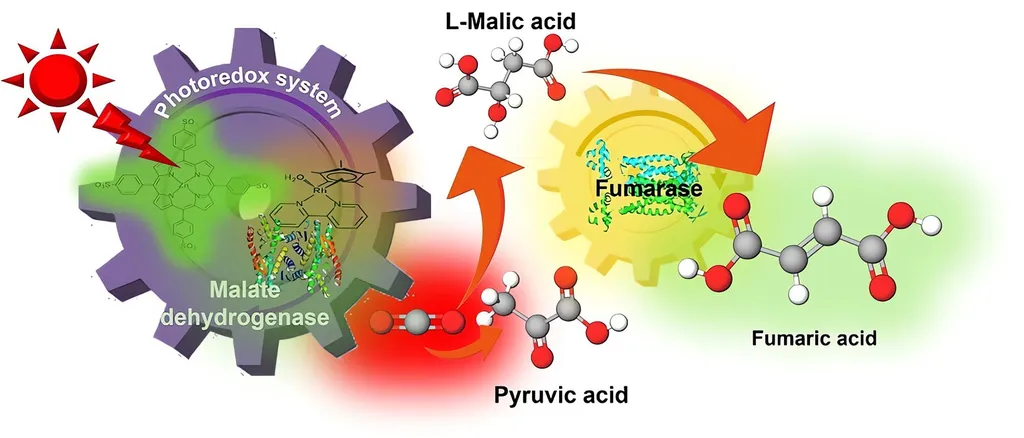
In a groundbreaking development that could revolutionize the way we handle plastic waste, researchers have turned to an unlikely ally: artificial photosynthesis. This innovative approach, detailed in a recent study led by Mengmeng Du from the School of Chemistry and Materials Engineering at Fuyang Normal University in China, promises to upcycle polyester plastics into valuable chemicals, offering a sustainable solution to the mounting plastic waste crisis.
The study, published in *Materials Futures* (which translates to *Materials Horizons* in English), explores how artificial photosynthesis can convert polyester plastics into useful products through partial oxidation under mild conditions. This method not only addresses the environmental challenge of plastic waste but also opens new avenues for the energy and chemical industries.
“Artificial photosynthesis offers a unique advantage over traditional plastic disposal and biological treatment approaches,” Du explained. “It allows us to convert waste into wealth by integrating plastic upcycling with water splitting and CO2 reduction, creating a closed-loop system that is both economically viable and environmentally friendly.”
The research outlines several pathways for polyester plastic conversion, including upcycling integrated with water splitting, valorization coupled with CO2 reduction, and organonitrogen synthesis from polyester. The study also discusses the design principles for developing high-performance photocatalysts, such as tuning redox potentials, promoting charge separation, enhancing substrate absorption, and leveraging photothermal-assisted photocatalysis.
One of the most compelling aspects of this research is its potential commercial impact. By converting waste plastics into valuable chemicals, this technology could significantly reduce the reliance on virgin materials, thereby lowering production costs and environmental impact. “The techno-economic assessment and life cycle assessment conducted in our study highlight the economic viability and environmental benefits of solar-driven plastic upcycling,” Du noted. “This technology has the potential to reshape the energy and chemical sectors by providing a sustainable and cost-effective solution for plastic waste management.”
The study also addresses future challenges and research perspectives, such as photocatalyst screening, reactor design, and the synthesis of multicarbon compounds. These insights provide a blueprint for the development of advanced photocatalysts for polyester plastic conversion, ultimately closing the carbon loop for postconsumer polyester plastics.
As the world grapples with the consequences of plastic pollution, this research offers a glimmer of hope. By harnessing the power of artificial photosynthesis, we can transform waste into valuable resources, paving the way for a more sustainable future. The findings not only highlight the potential of this technology but also underscore the need for continued innovation and investment in sustainable practices.
In the words of Du, “This review presents a blueprint for the development of advanced photocatalysts for polyester plastic conversion, thereby closing the carbon loop for postconsumer polyester plastics.” With such promising advancements on the horizon, the future of plastic waste management looks brighter than ever.