
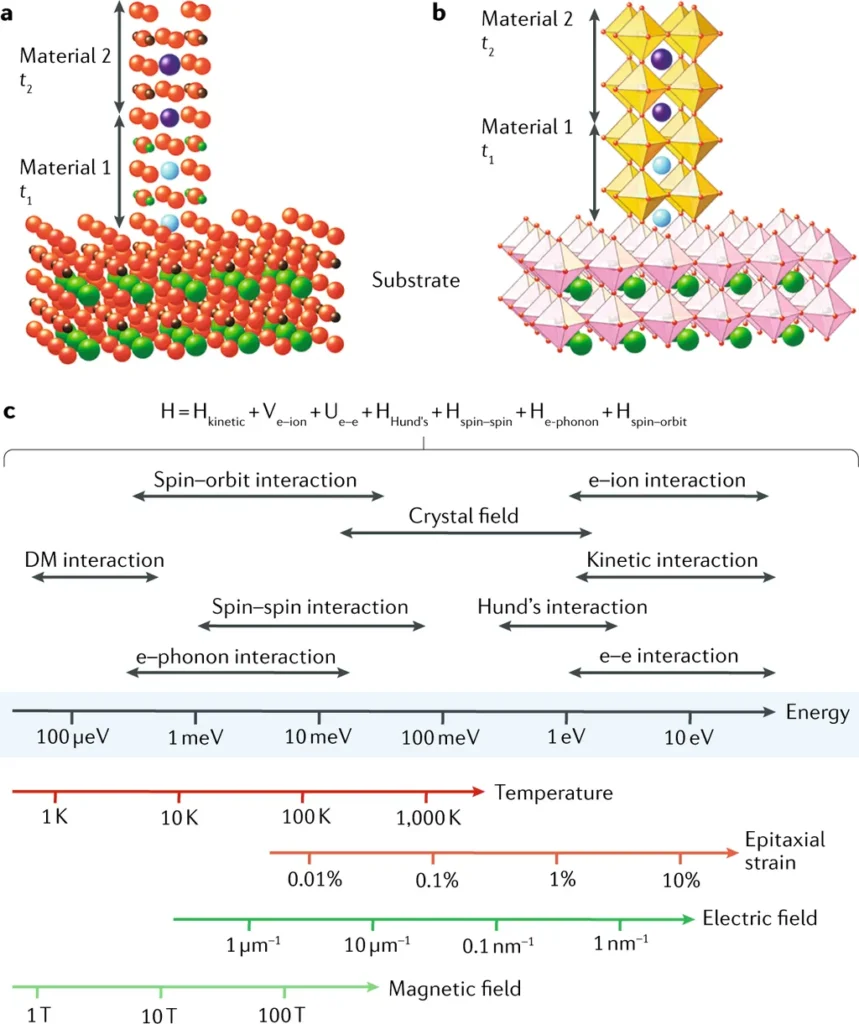
In a groundbreaking study published in *JPhys Materials* (which translates to *Journal of Physics Materials*), researchers have unlocked a new pathway to control the electronic and magnetic properties of oxide superlattices, potentially revolutionizing the energy sector. Led by Monirul Shaikh from the Department of Physics and Nanotechnology at SRM Institute of Science and Technology in India, the research delves into the intricate dance of structural, electronic, and magnetic degrees of freedom within these complex materials.
The study focuses on a specific oxide superlattice system, $(\mathrm{LaFeO}_3)_1/(\mathrm{CaFeO}_3)_1$, serving as a model to demonstrate the control of coupled structural modes. By employing a combination of symmetry-mode analysis, first-principles density functional theory calculations, and Berry-phase polarization computations, the team uncovered a previously unrecognized polar A-type charge-disproportionation mode, denoted as $Q_{\mathrm{ACD}}$. This mode couples with the hybrid-improper trilinear polar mode $Q_{\mathrm{Tri}}$, creating a multimode interaction that significantly lowers the material’s symmetry.
“This multimode interaction opens up a rich phase space,” explains Shaikh, “comprising polar metallic, semimetallic, and insulating ground states. It’s a fascinating interplay that we believe can be harnessed for various applications.”
The implications for the energy sector are profound. The ability to tune the electronic structure of these materials could lead to the development of more efficient energy storage devices, advanced sensors, and novel electronic components. The study reveals that the proposed design principle is generalizable across a broad class of transition metal oxide superlattices, offering a promising route toward engineering multifunctional quantum phases in oxide interfaces.
One of the most compelling aspects of this research is the potential to control the insulator-metal transition. By manipulating the structural modes, researchers can induce a transition from an insulating to a metallic state and back, accompanied by a controllable sublattice magnetization contrast. This tunability could pave the way for innovative energy solutions, such as more efficient solar cells and advanced thermoelectric materials.
As the world seeks sustainable and efficient energy solutions, the insights gained from this study could be a game-changer. The ability to engineer multifunctional quantum phases in oxide interfaces opens up new avenues for research and development in the energy sector. The study, published in *JPhys Materials*, not only advances our fundamental understanding of these complex materials but also sets the stage for future technological breakthroughs.
In the words of Shaikh, “This research is just the beginning. The principles we’ve uncovered could lead to a new era of materials science, with far-reaching implications for energy technologies.” As the scientific community continues to explore these findings, the potential for transformative impact on the energy sector becomes increasingly evident.