
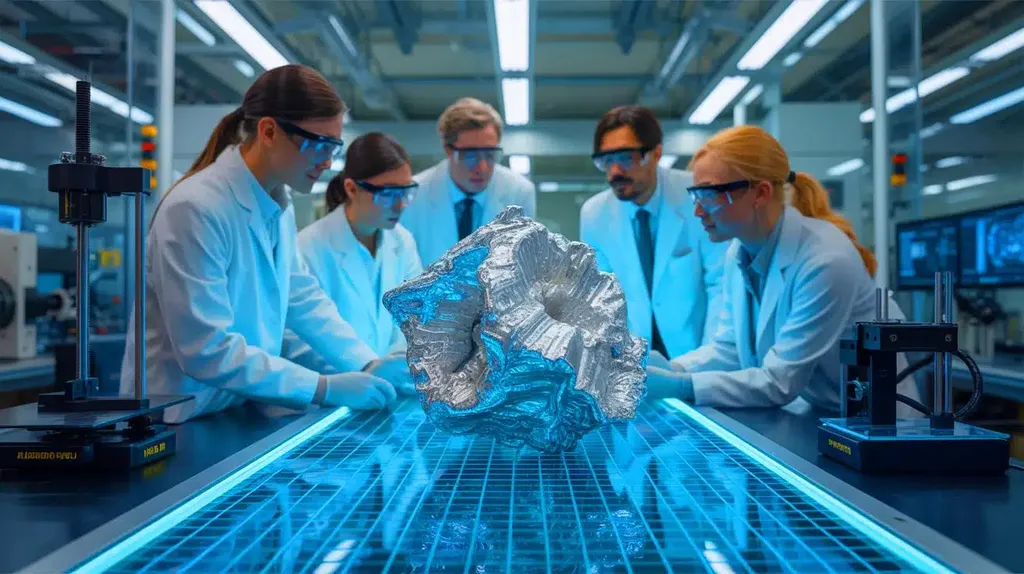
In a significant stride towards optimizing lightweight, high-strength materials, researchers have developed a novel machine learning approach to enhance the mechanical properties of particle-reinforced aluminum matrix composites (PAMCs). This breakthrough, led by Qingtao Jia of the State Key Laboratory of Advanced Marine Materials at the Ningbo Institute of Materials Technology and Engineering, Chinese Academy of Sciences, promises to revolutionize the design and application of advanced structural components, particularly in the energy sector.
PAMCs are highly sought after for their exceptional specific strength and processability, making them ideal candidates for lightweight applications. However, achieving a balance between various mechanical properties has been a persistent challenge due to the intricate interplay of compositions and processing parameters. To tackle this issue, Jia and his team curated a dataset of 192 entries from peer-reviewed literature and proposed a hybrid machine learning workflow named PAMCs-MP.
The PAMCs-MP workflow integrates transfer learning with transformer-based neural networks, leveraging a larger dataset of 1089 Al alloy entries to pre-train feature extractors. This innovative approach effectively overcomes the limitations posed by the relatively small PAMCs dataset, enabling accurate predictions of matrix-dependent mechanical properties.
“Our method not only improves the predictive accuracy but also provides valuable insights into the key determinants of PAMCs’ mechanical properties,” said Jia. The research revealed that electronic interactions among Si, Mg, and modification elements (Ce, B), as well as particle-driven dislocation strengthening, play crucial roles in determining the mechanical behavior of PAMCs.
The PAMCs-MP workflow demonstrated superior predictive accuracy compared to conventional machine learning models, achieving coefficients of determination of 92.4 ± 3.7% for ultimate tensile strength and 90.8 ± 4.4% for elongation. This enhanced accuracy paves the way for more efficient and targeted optimization of PAMCs, potentially reducing development costs and time in the energy sector.
The implications of this research extend beyond the immediate advancements in material science. By establishing an effective strategy for performance optimization of complex material systems with limited datasets, Jia’s work offers valuable insights for the broader application of transfer learning in material design. This could accelerate the development of next-generation materials tailored for specific industrial needs, particularly in sectors requiring lightweight, high-strength components.
As the energy sector continues to evolve, the demand for advanced materials that can withstand extreme conditions while maintaining lightweight properties is on the rise. The PAMCs-MP workflow developed by Jia and his team provides a powerful tool to meet these demands, potentially shaping the future of material design and application in the energy sector.
Published in the journal *Materials Futures* (translated to English as “Materials Future Horizons”), this research highlights the transformative potential of integrating advanced machine learning techniques with traditional material science approaches. By bridging the gap between data limitations and predictive accuracy, Jia’s work sets a new standard for optimizing complex material systems, offering a glimpse into the future of lightweight, high-strength materials in the energy sector and beyond.