
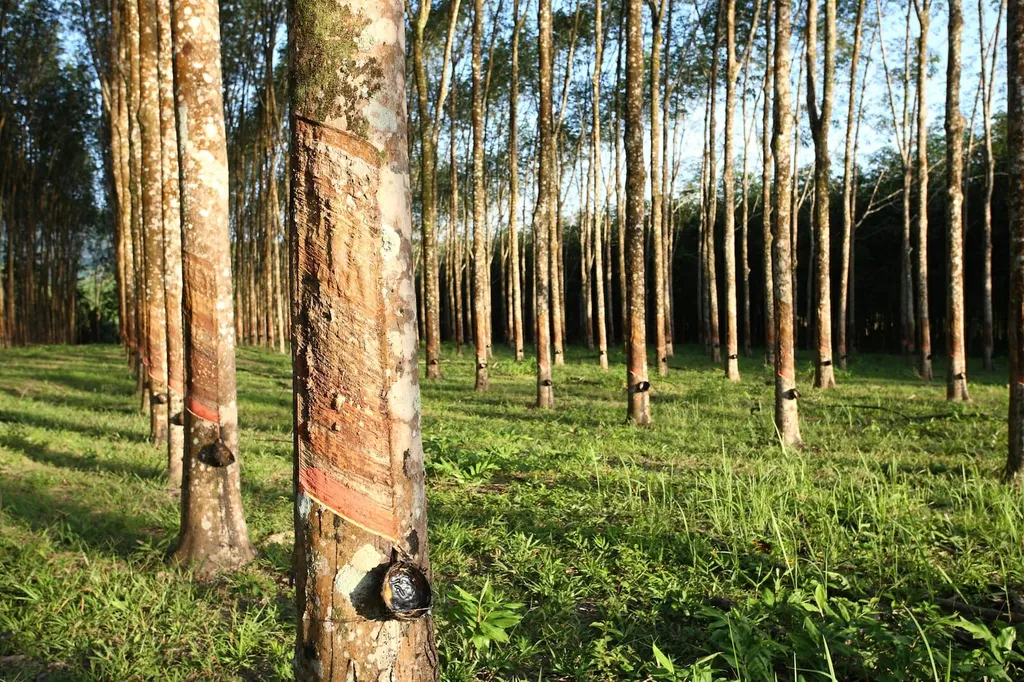
In the lush landscapes of Zamboanga Sibugay, Philippines, a silent revolution is taking root—one that could reshape the country’s wood industry. Researchers have been delving into the properties of rubber trees, specifically Hevea brasiliensis clones, to uncover their potential beyond the well-known latex production. The findings, published in the *Environment and Natural Resources Journal* (translated as *Journal of Environment and Natural Resources*), offer promising insights for the construction and furniture sectors.
At the forefront of this research is Oliver S. Marasigan, a scientist from the Physics and Mechanics Section of the Material Science Division at the Forest Products Research and Development Institute (FPRDI), under the Department of Science and Technology (DOST) in Los Baños, Laguna. Marasigan and his team have been assessing the anatomical, physical, and mechanical properties of 25-year-old rubber tree clones PB 260 and RRIM 600.
The study reveals that PB 260 exhibits significantly larger fiber dimensions compared to RRIM 600, with fibers that are 6.42% longer, 9.42% larger in diameter, and 22.47% wider in lumen. However, PB 260’s cell walls are thinner by 13.33%. “These differences in fiber dimensions can greatly influence the suitability of these clones for various applications,” Marasigan explains.
When it comes to physical properties, RRIM 600 shows a higher basic relative density, which contributes to its superior strength. This makes it an ideal candidate for construction, flooring, and cabinetry. “The thicker cell walls of RRIM 600 give it an edge in terms of strength and durability,” Marasigan notes.
On the other hand, PB 260, with its larger fiber dimensions and higher green moisture content, is well-suited for medium-grade furniture, carving, and pallets. The study highlights the potential of these Hevea brasiliensis clones as alternative raw materials for the Philippine wood industry, offering a sustainable and versatile resource.
The commercial implications of this research are substantial. As the demand for sustainable and locally sourced materials grows, the rubberwood industry could see a significant boost. This could lead to new opportunities for local farmers and manufacturers, fostering economic growth and innovation in the region.
Moreover, the findings could pave the way for further research into the properties of other rubber tree clones and their potential applications. As Marasigan puts it, “This is just the beginning. There’s so much more to explore in the world of rubberwood.”
In an era where sustainability and innovation are key drivers of industry growth, this research offers a glimpse into the future of the wood industry. By harnessing the potential of Hevea brasiliensis clones, the Philippines could be on the cusp of a wood revolution, one that promises to be as transformative as the rubber boom of the past.