
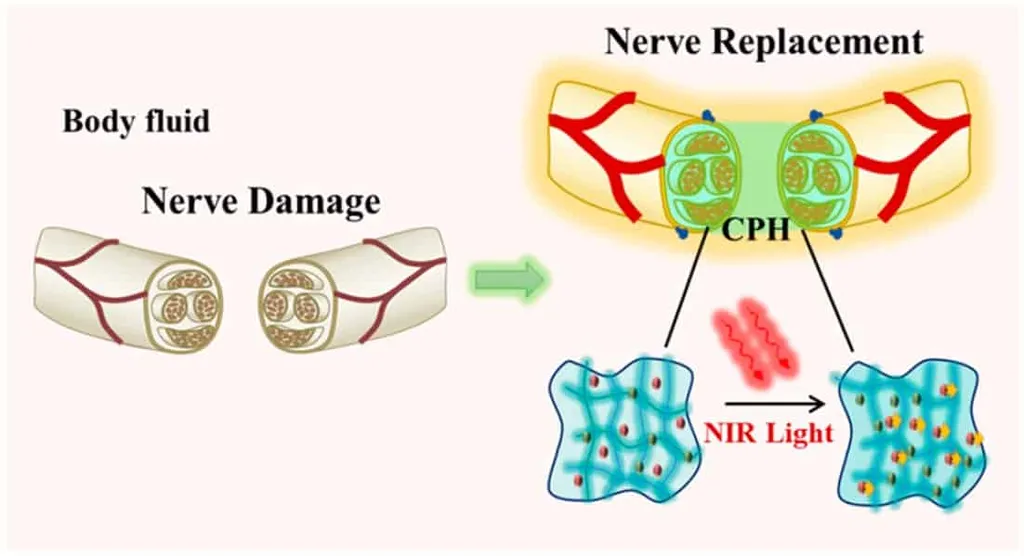
In a groundbreaking development poised to revolutionize nerve injury treatment, researchers from the Department of Otorhinolaryngology-Head & Neck Surgery at Xinhua Hospital, affiliated with Shanghai Jiao Tong University School of Medicine, have engineered a novel hydrogel that significantly enhances facial nerve recovery. Led by Dr. Chun Chen, the team’s innovative approach combines a photoactivated GelMA/HAMA composite hydrogel with bone marrow mesenchymal stem cell-derived exosomes (BExos), offering a promising solution for the challenging realm of nerve regeneration.
Facial nerve injuries, often resulting in incomplete functional restoration, have long posed a significant clinical challenge. Traditional treatment methods and bioengineered scaffolds have fallen short due to inadequate biological activity and unfavorable inflammatory conditions. Dr. Chen’s research, published in the journal *Bioactive Materials* (translated as *活性材料*), introduces a dual-action hydrogel that not only provides structural support but also actively modulates the inflammatory microenvironment to promote nerve regeneration.
The hydrogel’s unique composition facilitates the transdifferentiation of bone marrow stromal cells (BMSCs) into Schwann cell-like lineages, which are crucial for nerve repair. “Our BExos-integrated hydrogel creates a favorable niche that guides BMSCs toward Schwann cell-mimetic lineages, significantly enhancing neuromuscular functional restoration,” explains Dr. Chen. This innovative approach has demonstrated marked improvements in axonal regrowth, remyelination processes, and reduced oxidative damage compared to untreated cohorts.
One of the most striking findings is the hydrogel’s ability to shift macrophage differentiation from a pro-inflammatory (M1) state to an anti-inflammatory (M2) phenotype. This modulation of the immune response is achieved through the regulation of key signaling pathways, including PI3K/NF-κB/P38, with Neuronatin emerging as a pivotal regulatory element. “The synergistic effect of structural reinforcement and exosome-mediated immune regulation positions this hydrogel as a game-changer in facial nerve repair,” says Dr. Chen.
The implications of this research extend beyond the immediate clinical applications. The successful integration of exosomes into hydrogel scaffolds opens new avenues for developing advanced biomaterials that can actively interact with and modulate the biological environment. This innovative approach could inspire similar developments in other areas of regenerative medicine, potentially transforming the treatment of various nerve injuries and degenerative diseases.
As the field of bioengineered scaffolds continues to evolve, Dr. Chen’s work stands out as a beacon of progress. The dual-action hydrogel not only addresses the constraints of current regenerative approaches but also paves the way for future advancements in nerve repair and regenerative medicine. With further research and development, this technology could become a cornerstone in the treatment of facial nerve injuries, offering new hope to patients and reshaping the landscape of clinical care.