
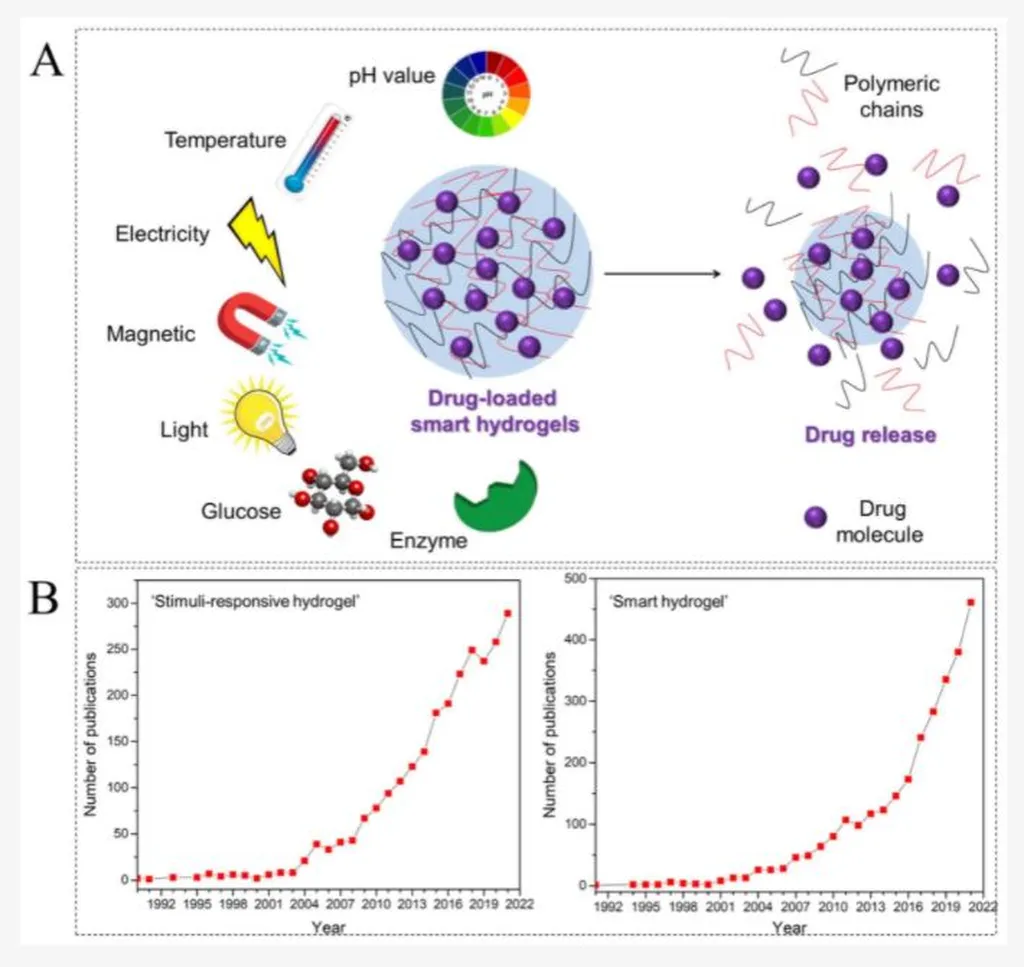
In the ever-evolving landscape of biomedical engineering, a groundbreaking study has emerged that could revolutionize drug delivery systems and potentially impact the energy sector. Researchers at the İzel Kimya Research and Development Center in Kocaeli, Turkey, led by Turdimuhammad Abdullah, have developed an innovative amphiphilic shape-memory hydrogel (SMH) that responds to both pH and temperature changes. This novel material, based on poly(acrylic acid-co-n-hexadecyl acrylate) [P(AAc-co-C16A)], integrates dual responsiveness within a single molecular network, offering a versatile platform for controlled drug release and potentially other applications.
The hydrogel’s unique properties stem from its composition. The hydrophobic C16 side chains form reversible crystalline domains that act as physical cross-links, providing thermal shape-memory and mechanical strength. Meanwhile, the ionizable acrylic acid units offer pH-dependent swelling and charge regulation. This dual responsiveness allows the hydrogel to adapt to different environmental conditions, making it highly suitable for biomedical applications.
One of the most compelling aspects of this research is the hydrogel’s ability to release drugs in a controlled manner. Ibuprofen-loaded SMHs demonstrated strongly pH-dependent and thermally accelerated drug release. “The hydrogel releases the drug more effectively under mildly acidic conditions, which is particularly relevant for targeting cancer cells,” explains Abdullah. This selective cytotoxicity towards MDA-MB-231 breast cancer cells highlights the hydrogel’s potential in cancer therapy.
The mechanical robustness of the hydrogel, with a Young’s modulus of approximately 15 MPa and a high shape-recovery ratio of over 93%, makes it a promising candidate for various applications. The thermoresponsive transition near physiological temperature (37°C–39°C) further enhances its suitability for biomedical uses. “This hydrogel provides a molecularly tunable platform that couples shape-memory functionality with controlled, dual-stimulus drug delivery,” says Abdullah.
The implications of this research extend beyond biomedical applications. The hydrogel’s ability to respond to environmental stimuli and its mechanical resilience could also be leveraged in the energy sector. For instance, it could be used in the development of smart materials for energy storage or as responsive coatings for pipelines, enhancing their durability and efficiency.
The study, published in ‘Makromolekulare Materialien und Engineering’ (Macromolecular Materials and Engineering), opens new avenues for localized and on-demand release systems. The combination of reversibility, biocompatibility, and mechanical resilience offers exciting opportunities for next-generation 4D-printed biomedical devices and beyond.
As the field of biomedical engineering continues to advance, the development of such innovative materials will play a crucial role in shaping the future of healthcare and other industries. The research conducted by Turdimuhammad Abdullah and his team at the İzel Kimya Research and Development Center represents a significant step forward in this exciting and rapidly evolving field.