
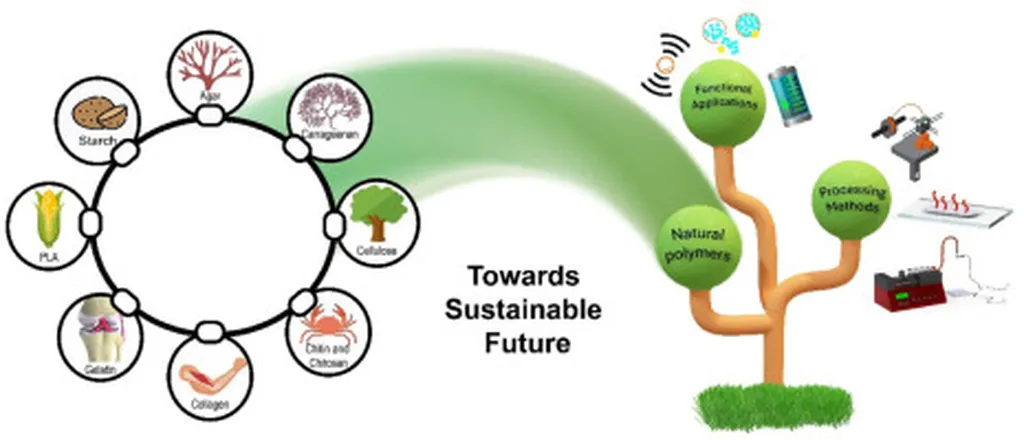
In a significant stride towards sustainable materials, researchers have successfully synthesized and analyzed a new series of bio-based copolymers that could reshape the future of the energy sector. The study, led by Konrad Walkowiak from the Faculty of Mechanical Engineering and Mechatronics at the West Pomeranian University of Technology in Szczecin, Poland, combines experimental and mathematical approaches to explore the potential of these innovative polymers.
The research focuses on poly(trimethylene 2,5-furandicarboxylate) (PTF), a fully bio-based polyester that serves as a promising alternative to petroleum-derived poly(trimethylene terephthalate) (PTT). “PTF offers properties comparable to PTT, but its bio-based nature aligns with the global push towards reducing reliance on fossil feedstocks,” Walkowiak explains.
The team synthesized two series of bio-based copolymers: poly(trimethylene terephthalate-co-trimethylene glutarate) (PTT-co-PTG) and poly(trimethylene 2,5-furandicarboxylate-co-trimethylene glutarate) (PTF-co-PTG) using melt polycondensation. This method is particularly appealing for industrial applications due to its energy efficiency and cost-effectiveness.
To understand the impact of incorporating PTG units, the researchers employed differential scanning calorimetry (DSC) to investigate thermal properties and morphology. The results revealed no significant differences in thermal stability and activation energy between the homopolymer and the corresponding copolymers, suggesting that the introduction of PTG units does not compromise these critical properties.
The study, published in the journal *Macromolecular Materials and Engineering* (translated to English as “Macromolecular Materials and Engineering”), highlights the potential of these bio-based copolymers for various applications in the energy sector. “The ability to maintain thermal stability while incorporating bio-based units opens up new avenues for sustainable materials in energy storage and conversion devices,” Walkowiak notes.
This research not only advances our understanding of bio-based polymers but also paves the way for future developments in sustainable materials. As the world continues to seek alternatives to fossil-based products, the insights gained from this study could be instrumental in shaping the future of the energy sector.