
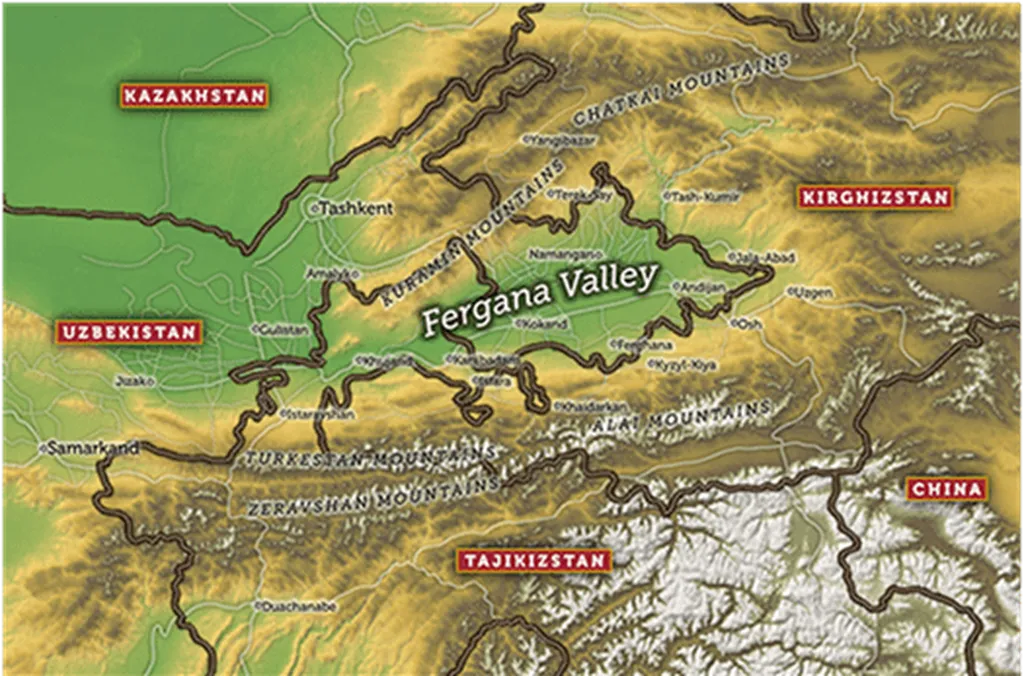
In the heart of Central Asia, the Ferghana Valley is a region where water is not just a resource but a lifeline, crucial for irrigation and livelihoods. Yet, cooperation over the small transboundary tributaries (STTs) that crisscross the borders of Kyrgyzstan and Uzbekistan has been anything but straightforward. A recent study published in the journal ‘Frontiers in Water’ (translated as ‘Frontiers in Water’) sheds light on the intricate dynamics of water cooperation in this vital region, offering insights that could reshape future strategies and commercial impacts for the energy sector.
Bunyod Holmatov, a researcher at the International Water Management Institute (IWMI) in Colombo, Sri Lanka, led the study that delves into the drivers and barriers of formal cooperation on STTs in the Ferghana Valley. “While large rivers in the region have been extensively studied, the dynamics surrounding smaller tributaries have remained ambiguous,” Holmatov explains. His team conducted semi-structured interviews with regional water experts to uncover the key factors at play.
The findings reveal that the expansion of irrigated lands and the construction of water infrastructure have historically driven cooperation. However, present-day barriers are more complex, including border demarcation issues, a lack of political will, the low cost of water, and poor intra-sectoral coordination. “Actors identified as key to enabling formal water cooperation are water and agriculture specialists,” Holmatov notes, highlighting the importance of these experts in fostering collaboration.
One of the most compelling aspects of the study is its emphasis on informal cooperation as a foundation for scaling up to formal agreements. This insight could have significant commercial implications for the energy sector, particularly in hydropower development, which relies heavily on stable water management practices. By understanding and leveraging informal networks, stakeholders can build trust and pave the way for more robust, formal cooperation.
The study also offers three concrete recommendations to strengthen cooperation in STTs within the Ferghana Valley. First, enhancing intra-sectoral coordination, planning, and information exchange is crucial. Second, stimulating appreciation for the benefits of water cooperation can enhance political will. Third, resolving non-water issues such as border delineation before initiating water cooperation discussions is essential to avoid undermining efforts.
As the energy sector increasingly turns to hydropower and other water-dependent technologies, the insights from this study become even more relevant. Effective water management is not just about environmental sustainability; it’s about ensuring the stability and profitability of energy projects. By addressing the barriers to cooperation and leveraging the drivers identified in the study, stakeholders can create a more cooperative and commercially viable landscape.
In a region where water is a lifeline, the findings from Holmatov’s research offer a roadmap for fostering cooperation and ensuring the sustainable management of this vital resource. As the energy sector continues to evolve, the lessons learned in the Ferghana Valley could serve as a model for other transboundary water management challenges around the world.