
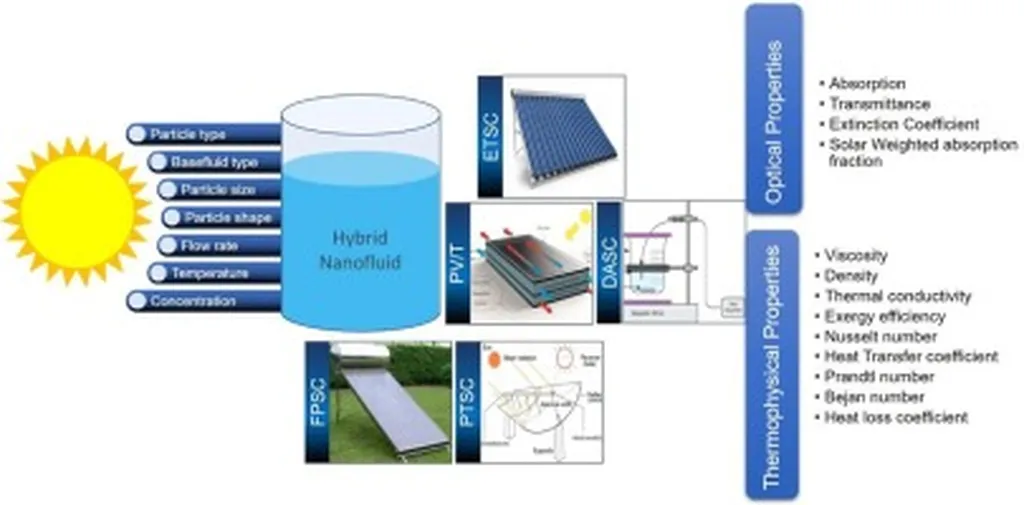
In the quest for more efficient energy systems, researchers have turned to nanotechnology to enhance the performance of heat exchangers, crucial components in power generation and distribution. A recent study led by Devireddy Sandhya from the University of South Africa’s Department of Mechanical, Bioresource and Biomedical Engineering has shed light on the potential of hybrid nanofluids to revolutionize thermal management in the energy sector.
The study, published in the journal “Advances in Mechanical and Materials Engineering” (translated as “Advances in Mechanical and Materials Engineering”), compares the thermo-hydraulic performance of two types of nanofluids: one containing magnesium oxide nanoparticles dispersed in transformer oil (MgO/TrO) and a hybrid nanofluid combining magnesium oxide and copper oxide nanoparticles (MgO-CuO/TrO). The findings could have significant implications for the design and operation of heat exchangers in power plants and other energy-intensive industries.
Heat exchangers are vital for transferring heat between fluids, and their efficiency directly impacts the overall performance of energy systems. By dispersing nanoparticles in transformer oil, researchers aim to enhance the oil’s thermal conductivity, thereby improving heat transfer rates. Sandhya’s study reveals that the hybrid nanofluid outperforms the single-component MgO/TrO nanofluid in several key metrics.
“The hybrid nanofluid showed a remarkable enhancement in heat transfer characteristics,” Sandhya explains. “We observed up to a 55% increase in the Overall Heat Transfer Coefficient and a 27% increase in the Nusselt number compared to the MgO/TrO nanofluid.” These improvements translate to more efficient heat dissipation, which can lead to better performance and reduced energy losses in power generation equipment.
However, the benefits come with trade-offs. The hybrid nanofluid exhibited higher friction factors and required greater pumping power, ranging from 2.2% to 3.8% more than the MgO/TrO nanofluid. “While the increased pumping power is a consideration, the overall thermal performance gains are substantial,” Sandhya notes. “The trade-off may be justified in applications where heat transfer efficiency is critical.”
The study’s findings suggest that hybrid nanofluids could play a pivotal role in enhancing the efficiency of heat exchangers in the energy sector. As power plants and industrial facilities strive to optimize their operations and reduce energy consumption, innovative solutions like these nanofluids offer promising avenues for improvement.
The research also highlights the importance of continued exploration into the thermo-hydraulic properties of nanofluids. By understanding the interplay between different nanoparticles and base fluids, engineers can develop more effective cooling strategies for a wide range of applications.
As the energy sector continues to evolve, the integration of advanced materials and technologies will be crucial in meeting the demands for efficiency and sustainability. Sandhya’s work underscores the potential of hybrid nanofluids to drive progress in thermal management, paving the way for more efficient and environmentally friendly energy systems.