
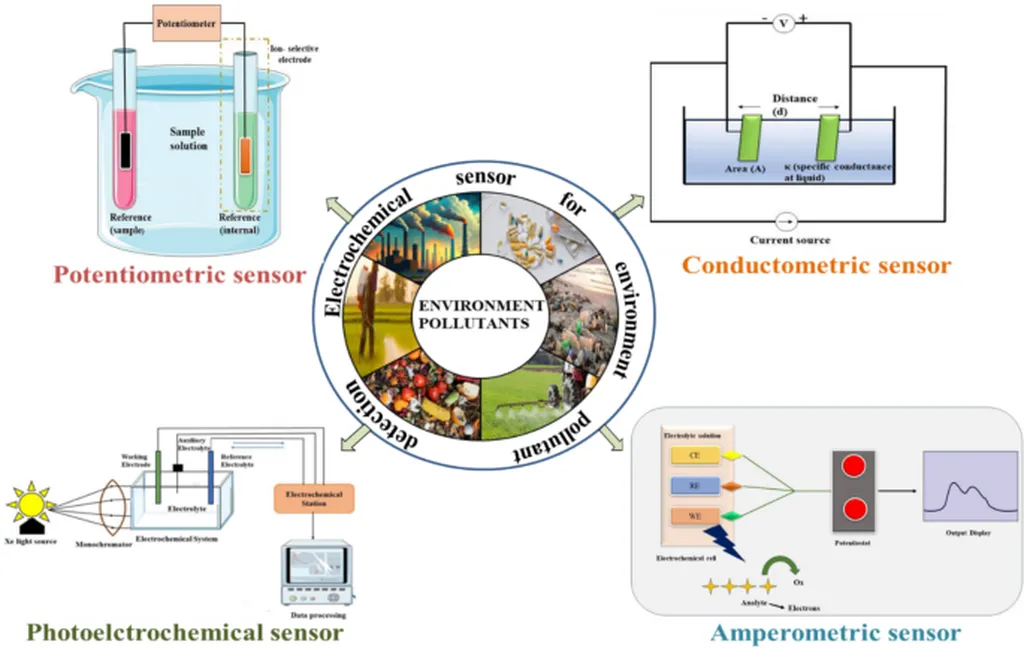
In the realm of electrochemical sensing, a novel development has emerged that could significantly impact the energy sector and beyond. Researchers have introduced a PC-based, differential pulse voltammetry (DPV)-exclusive potentiostat, dubbed the differential pulse analyte detector. This innovation, led by Aman Dubey from the Department of Physics at the University of Jammu, India, represents a leap forward in cost-effective, field-deployable sensing technology.
Traditional low-cost potentiostats often come with hardware overhead and power consumption issues, but Dubey’s design addresses these challenges head-on. “Our system employs a DPV-specific design, which minimizes hardware overhead, reduces power consumption, and enhances measurement stability,” Dubey explains. The device is built around an ATmega16A microcontroller and an MCP4725 digital-to-analog converter, ensuring precise timing and waveform integrity without the need for analog RC-based shaping circuits.
One of the standout features of this new potentiostat is its counter-electrode excitation strategy, which maintains reference electrode stability and suppresses capacitive background currents. This, combined with a selectable transimpedance amplifier (1 kΩ–1 MΩ), provides a wide dynamic current range and a ±2 V operating window, surpassing several existing low-cost potentiostats.
The analytical performance of the device was validated using malathion as an analyte, achieving a sensitivity of 0.43 μA nM ^−1 and a limit of detection of 3.34 nM, comparable to a commercial CHI 660E workstation. The system’s usability is further enhanced by an intuitive Visual Basic–based graphical user interface, making it accessible for non-expert users.
Published in the journal ‘ECS Sensors Plus’—which translates to ‘Electrochemical Society Sensors Plus’—this research opens up new possibilities for field-deployable sensing platforms. The differential pulse analyte detector’s cost-effectiveness and expandability make it a promising tool for various applications, including environmental monitoring, food safety, and industrial process control.
As the energy sector increasingly relies on advanced sensing technologies for efficiency and safety, innovations like the differential pulse analyte detector could play a pivotal role. By providing accurate, stable, and cost-effective sensing solutions, this technology has the potential to shape future developments in the field, driving progress and innovation in electrochemical sensing applications.