
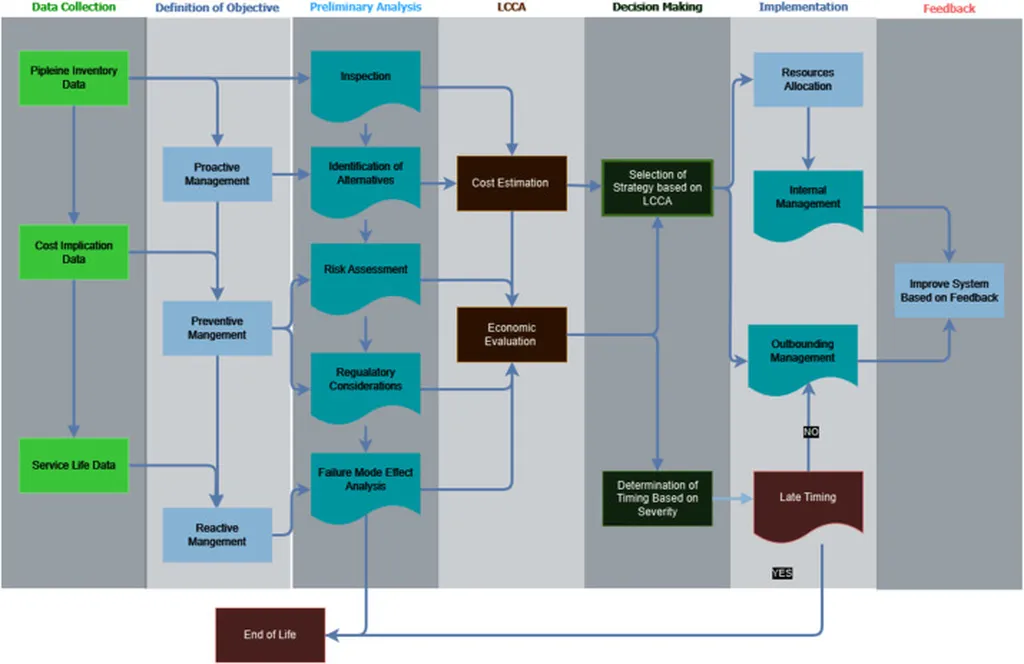
In the vast network of pipelines that crisscross the globe, transporting oil and gas over thousands of miles, a silent revolution is brewing. Researchers are increasingly turning to advanced data analytics and decision support systems to manage pipeline integrity more effectively, and a recent study published in the *Journal of Pipeline Science and Engineering* (translated from the original title in Malay) sheds light on the potential of integrating life cycle cost analysis (LCCA) into decision support systems (DSS) for pipeline asset management.
The study, led by Adamu Abubakar Sani from the Department of Civil and Environmental Engineering at Universiti Teknologi PETRONAS in Malaysia, reveals a significant gap in current research efforts. Despite the extensive body of work on DSS and LCCA individually, there is a notable lack of studies exploring their integration, particularly in the context of pipeline integrity management. “The challenges are worsened by aging pipeline infrastructure, emphasizing the importance of a proactive approach throughout the pipeline’s life cycle,” Sani notes.
Traditional pipeline management has often been reactive, addressing faults after they occur. This approach can lead to inefficiencies, safety issues, and increased costs. The integration of LCCA-based DSS offers a proactive solution, enabling decision-makers to consider the full life cycle costs of pipelines, from construction and operation to maintenance and decommissioning.
The study’s bibliometric review, which analyzed data from Elsevier’s Scopus and Web of Science databases, found that while there is substantial research on DSS and LCCA separately, only a handful of studies have explored their integration. This indicates a limited research effort in this domain, with North America, Europe, and Asia leading the way. The United States, Canada, and China are the top contributors, while regions like South America and Africa show minimal research activity.
The potential commercial impacts for the energy sector are substantial. By adopting LCCA-based DSS, companies can enhance the effectiveness of pipeline management, reduce costs, and improve safety. “The implementation of this framework can address technical, financial, and operational challenges, transforming pipeline asset integrity management,” Sani explains.
The study highlights the need for more research in this area, as the current body of knowledge is limited. The proposed LCCA-based DSS framework aims to bridge this gap, offering a comprehensive approach to pipeline asset integrity management. As the energy sector continues to evolve, the integration of advanced analytics and decision support systems will play a crucial role in ensuring the reliability, economic viability, and sustainability of oil and gas infrastructure.
In the words of Sani, “By integrating LCCA-based DSS into reality, pipeline asset integrity management will be transformed, and oil and gas infrastructure will have a reliable, economical, and sustainable future.” This research not only underscores the importance of proactive maintenance but also paves the way for future developments in the field, shaping the future of pipeline management in the energy sector.