
In the quest to enhance the longevity and performance of lithium-ion batteries, researchers have turned to an unexpected ally: borate additives. A recent study, led by Defu Li from the Energy Storage and Distributed Resources Division at Lawrence Berkeley National Laboratory, has shed light on the potential of lithium-free borate additives to significantly extend the cycle life of silicon-anode lithium-ion batteries. Published in the journal ‘Small Science’ (translated to English as ‘Small Science’), the findings could pave the way for more durable and efficient energy storage solutions, crucial for the energy sector’s ongoing transition to renewable sources.
Silicon-anode lithium-ion batteries have long been touted for their high energy density, but their limited cycle life and poor calendar life have hindered large-scale commercialization. Integrating additives into electrolytes has emerged as a simple and cost-effective strategy to improve these aspects. Li and his team systematically investigated the influence of five lithium-free borate additives, each with distinct molecular structures and elemental compositions.
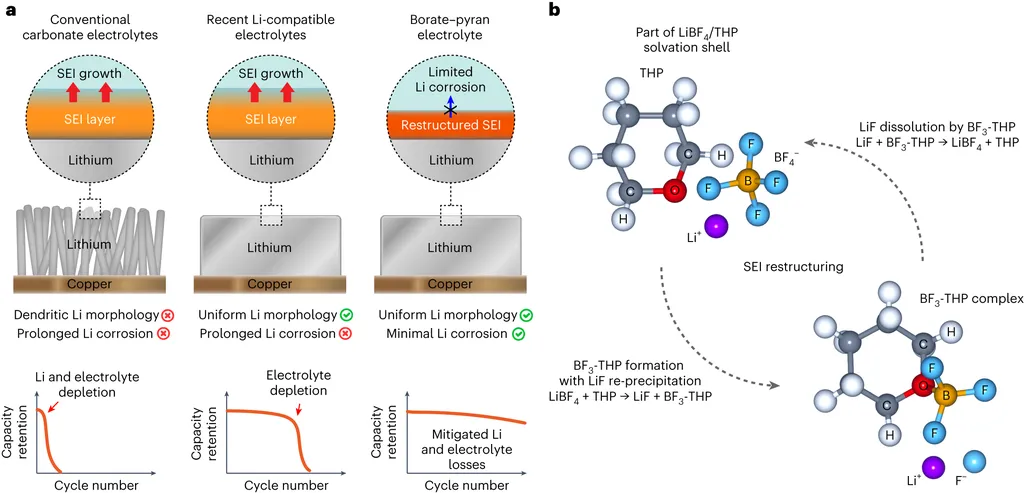
The results were striking. The addition of just 1% by volume of tri(2,2,2-trifluoroethyl) borate to the baseline electrolyte nearly doubled the cycle life at 50% state of health. “This enhancement is attributed to three key factors,” explained Li. “First, borate additives improve electrochemical activity. Second, they act as anion receptors that interact with [PF6]− anions and carbonate solvents to reduce electrolyte decomposition. Third, they promote the formation of a stable and polymeric solid electrolyte interphase layer.”
These findings are not just academic; they have significant commercial implications. As the energy sector increasingly relies on renewable sources, the demand for durable and efficient energy storage solutions has never been higher. Silicon-anode lithium-ion batteries, with their high energy density, could play a pivotal role in this transition. However, their limited cycle life has been a major hurdle. The discovery that lithium-free borate additives can significantly extend cycle life could be a game-changer.
Moreover, the study’s findings provide insight into the role of lithium-free borate additives in improving cycle life while addressing the knowledge gap regarding their influence on calendar aging. “These additives exhibited negligible impact in mitigating leakage current during a 180-hour voltage-hold calendar-aging test, indicating their limited effect in calendar life,” noted Li. This nuanced understanding could guide future research and development efforts, ensuring that the benefits of borate additives are fully realized.
The research published in ‘Small Science’ not only advances our scientific understanding but also offers practical solutions for the energy sector. As the world grapples with the challenges of climate change and the need for sustainable energy, innovations in battery technology are more important than ever. The work of Li and his team is a testament to the power of scientific inquiry to drive progress and shape the future of energy storage.