
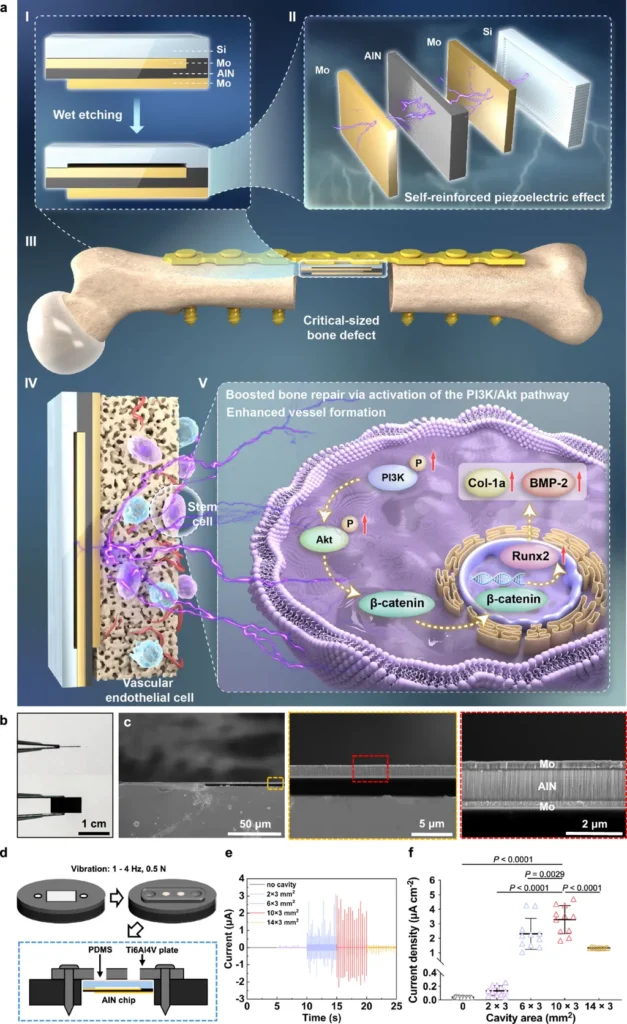
In the realm of tissue engineering, a groundbreaking study led by Jiye Jia from the State Key Laboratory of Precision Manufacturing for Extreme Service Performance at Central South University in China is making waves. The research, published in the *International Journal of Extreme Manufacturing* (which translates to *Extreme Manufacturing Technology Journal*), introduces a novel approach to tissue regeneration using piezoelectric scaffolds. These aren’t your average scaffolds; they’re designed to actively participate in the healing process by generating electrical activity when deformed, creating an electrochemical microenvironment that accelerates tissue repair.
The study systematically reviews various piezoelectric materials used in tissue engineering, including ceramics, synthetic polymers, and natural biological materials. Each has its own set of advantages and limitations, but the common thread is their ability to convert mechanical energy into electrical energy. This property is highly dependent on the fabrication and post-treatment strategies, which the researchers delve into with meticulous detail.
Jia explains, “The piezoelectric properties mainly stem from the asymmetric crystal structure of materials and the directional arrangement of internal dipoles.” This means that the way the materials are structured and processed can significantly enhance their piezoelectric performance. The study covers both traditional fabrication techniques and additive manufacturing methods, highlighting how each can influence the final product’s properties.
But it’s not just about the materials and fabrication techniques. The structural design of the piezoelectric scaffold plays a crucial role as well. By altering strain transmission pathways and charge distribution, or adding new operational modes, researchers can fine-tune the scaffold’s piezoelectric properties. The study explores various structural designs, from piezoelectric metamaterials and micro/nanostructures to porous, heterogeneous, and biomimetic structures.
So, what does this mean for the future of tissue engineering? The potential is immense. The study reviews the functions of piezoelectric scaffolds in bone regeneration, neural regeneration, antibacterial activity, and even intelligent sensing. Imagine a future where implants not only replace damaged tissue but also actively promote healing and integrate seamlessly with the body.
For the energy sector, this research could open up new avenues for energy harvesting and storage. Piezoelectric materials can convert mechanical energy from vibrations, impacts, or even footsteps into electrical energy. This could be particularly useful in remote or extreme environments where traditional power sources are not feasible. As Jia puts it, “The applications are vast, and the potential is just beginning to be tapped.”
However, the journey is not without its challenges. The study also discusses the hurdles that need to be overcome, such as improving the biocompatibility and mechanical properties of the scaffolds, and scaling up the fabrication processes. But with each challenge comes an opportunity for innovation, and the future of tissue engineering looks brighter than ever.
In the words of Jia, “The field of piezoelectric scaffolds is ripe for exploration, and we are excited to be at the forefront of this exciting journey.” As we stand on the brink of a new era in tissue engineering, one thing is clear: the future is electric.