
In the bustling world of construction and infrastructure development, particularly in the energy sector, the stability of foundation pits is paramount. A recent study published in the journal ‘Zhongwai Gonglu’ (which translates to ‘China Foreign Highway’) has shed new light on optimizing support structures for these critical excavations. The research, led by ZHOU Yi from the School of Civil and Environmental Engineering at Changsha University of Science & Technology, focuses on the innovative use of inclined-vertical combined double-row interlocked steel pipe piles.
The study addresses a common challenge in foundation pit engineering: how to minimize horizontal displacement and bending moments in support structures, especially in the context of underground tunnels for projects like the Hong Kong International Airport (HKIA). Traditional vertical double-row piles have been the go-to solution, but they come with limitations.
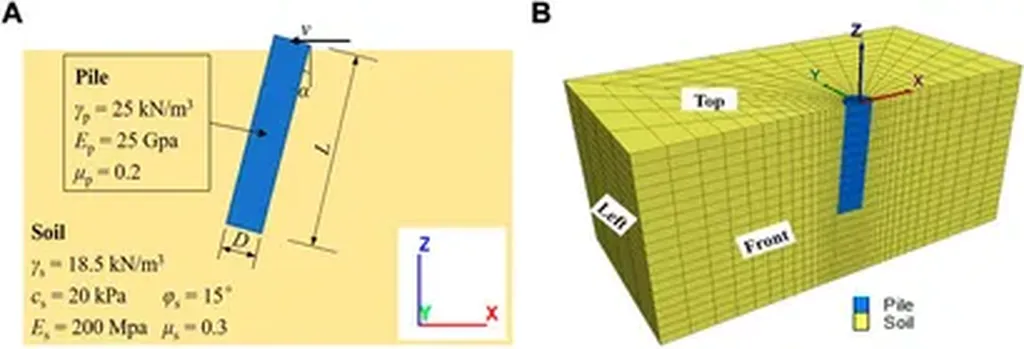
ZHOU Yi and his team conducted numerical simulations using finite element software Midas GTS NX to analyze different combination types and inclination angles of the piles. The results were striking. The inclined-vertical combined double-row piles reduced the horizontal displacement at the top of the inner-row piles by approximately 50% and decreased the peak bending moment by around 30%. This is a significant improvement over traditional methods.
“The positive-negative inclined double-row piles outperformed other combinations in controlling the horizontal displacement at the top and reducing the peak bending moment and the deflection of the piles,” ZHOU Yi explained. This finding is particularly relevant for the energy sector, where the stability of foundation pits is crucial for the construction of underground facilities such as tunnels and storage areas.
The study recommends prioritizing positive-negative inclined double-row piles or inward-vertical inclined double-row piles and maximizing the inclination angle within the allowable limits of construction equipment. This approach can lower the horizontal displacement at the top, peak bending moment, and deflection of the piles, ensuring the stability of foundation pits.
The implications of this research are far-reaching. For the energy sector, it offers a more efficient and stable solution for foundation pit support, which can lead to cost savings and improved safety. As ZHOU Yi noted, “This can ensure the stability of foundation pits, which is crucial for the construction of underground facilities.”
The study published in ‘Zhongwai Gonglu’ not only provides a scientific basis for optimizing support structures but also paves the way for future developments in the field. As the energy sector continues to expand and diversify, the need for stable and efficient foundation pit support will only grow. This research offers a promising solution that could shape the future of construction and infrastructure development.