
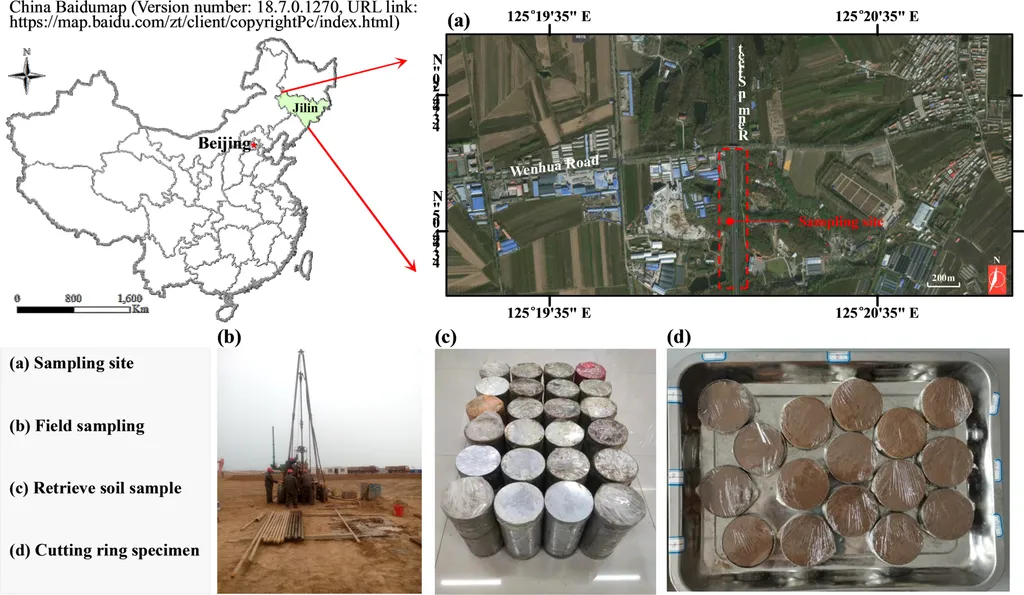
In the heart of China, a groundbreaking study is reshaping how engineers approach subgrade construction, particularly in areas rich with silty clay. LI Mingchao, a researcher from CCCC Second Highway Engineering Co., Ltd., has published a study in the journal *Zhongwai Gonglu* (which translates to “China and Foreign Highway”) that delves into the creep mechanical properties of silty clay, offering insights that could significantly impact the energy sector and infrastructure development.
The study focuses on the Zhoukou–Pingdingshan highway project, a critical artery in China’s transportation network. The research conducted one-dimensional creep tests on silty clay samples with varying compaction degrees under different stress levels. The findings are nothing short of transformative. “Under the same stress level, with the increase of compaction degree, the instantaneous strain, creep strain, and total strain of the samples all decrease significantly,” LI Mingchao explains. This means that higher compaction degrees can substantially reduce the long-term deformation of silty clay, a common challenge in subgrade engineering.
The implications for the energy sector are profound. Silty clay is often encountered in the construction of pipelines, power lines, and other critical infrastructure. Understanding its creep behavior can prevent costly failures and ensure the longevity of these projects. “The compaction degree has the most obvious inhibitory effect on the creep strain of the samples,” LI Mingchao notes. This insight could lead to more efficient and cost-effective construction practices, as engineers can now better predict and control the behavior of silty clay under different stress conditions.
The study also established corresponding creep constitutive models, providing a theoretical basis for preventing and controlling creep failure in silty clay subgrades. These models can be used to simulate the long-term behavior of silty clay under various conditions, allowing engineers to design more robust and reliable infrastructure. “The variation laws of the void ratio-logarithm of time (e-lg t) curves of samples with different compaction degrees are basically consistent, which can all be divided into three stages,” the research reveals. This consistency suggests that the models can be applied broadly, enhancing their utility in practical engineering scenarios.
The research also found that under the same stress level, the parameters E1, E2, η1, and η2 in the Burgers model all show an increasing trend with the increase of compaction degree. This indicates that higher compaction degrees lead to reduced instantaneous elastic deformation, viscoelastic deformation, and steady-state creep rate, while increasing the duration of the stable-state creep stage. These findings could revolutionize how engineers approach the compaction of silty clay, leading to more stable and durable subgrades.
As the energy sector continues to expand, the need for reliable and efficient infrastructure becomes ever more critical. This research provides a crucial tool for engineers, offering a deeper understanding of silty clay’s behavior and paving the way for more innovative and effective construction practices. “This study offers a theoretical basis for the prevention and control of creep failure in silty clay subgrades in engineering practice,” LI Mingchao concludes. With these insights, the future of subgrade engineering looks brighter and more promising than ever before.