
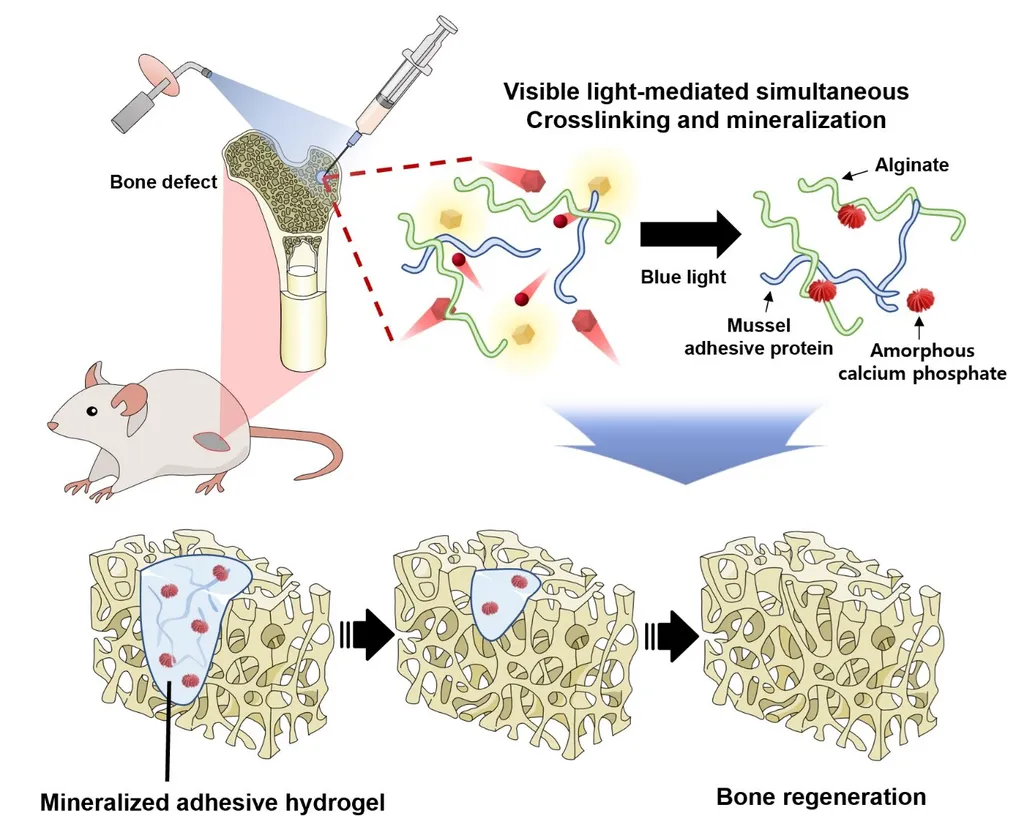
In the realm of bone regeneration, a groundbreaking study has emerged, offering a promising solution for minimally invasive procedures. Researchers, led by Moothedath Abhijith from the Aster Research Foundation in India, have developed an injectable composite hydrogel that could revolutionize orthopaedic, craniofacial, and spinal applications. This innovative material, detailed in a recent paper published in *Materials Research Express* (which translates to “Materials Research Express” in English), combines polyethylene glycol diacrylate (PEGDA) and nano-hydroxyapatite (nHAp) to create a biomimetic environment conducive to bone healing.
The study focuses on engineering bioactive polymer composites with injectability and controlled in situ curing, addressing a critical need in the medical field for less invasive bone regeneration techniques. “The integration of nHAp within the PEGDA matrix creates a biomimetic environment that supports cellular infiltration and mineralization,” Abhijith explained. This injectable nature allows for precise defect filling with minimal surgical intervention, a significant advancement over traditional methods.
The research team evaluated various formulations, finding that hydrogels containing 5% PEGDA and 7.5% nHAp with minimal initiator concentration exhibited the most favorable properties. These formulations combined controlled swelling, slower degradation, and mechanical robustness, making them ideal for bone defect repair. The cytocompatibility assessment using MTT assay on L929 fibroblasts confirmed that the 7.5% nHAp formulation maintained higher metabolic activity compared to higher loadings, indicating good biocompatibility.
The implications of this research are far-reaching. By offering osteoconductivity, biocompatibility, and stability, the PEGDA/nHAp hydrogels show potential for clinical translation in various medical applications. This could lead to more efficient and less invasive treatments, ultimately improving patient outcomes and reducing recovery times.
As the field of biomaterials continues to evolve, this study paves the way for future developments in bone regeneration. The commercial impacts for the energy sector, particularly in medical technology and biotechnology, are substantial. The development of such advanced materials could drive innovation in regenerative medicine, creating new opportunities for companies and researchers alike.
In summary, the research led by Abhijith and his team at the Aster Research Foundation represents a significant step forward in the quest for effective, minimally invasive bone regeneration solutions. With its promising results and potential for clinical translation, this study is poised to shape the future of orthopaedic and related medical fields.