
In the ever-evolving landscape of construction materials, steel fiber-reinforced concrete (SFRC) has emerged as a formidable contender, offering superior mechanical properties and durability. However, predicting its compressive strength—a critical performance indicator—has traditionally been a time-consuming and resource-intensive process. Enter Weihua Liu, a researcher from the Faculty of Land Resources Engineering at Kunming University of Science and Technology, who has pioneered a groundbreaking predictive framework that could revolutionize the way we approach SFRC.
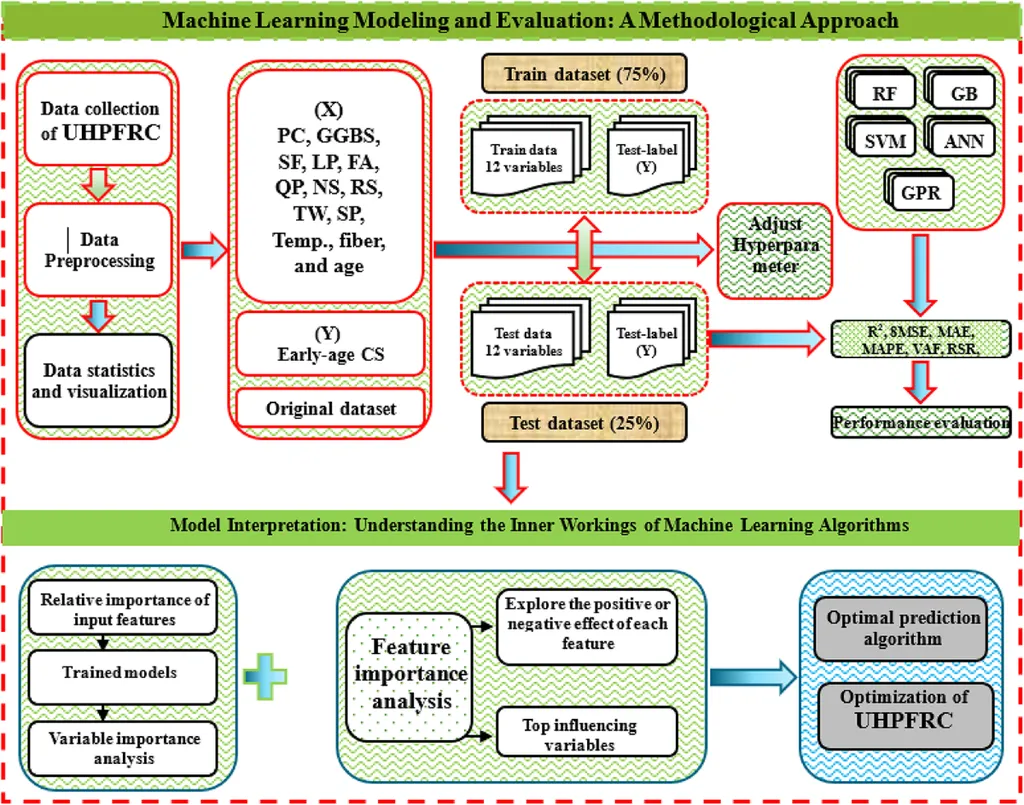
Liu’s innovative approach leverages the power of stacking ensemble learning, a sophisticated machine learning technique that combines multiple models to improve predictive accuracy. By integrating four base learners—Support Vector Machine (SVM), Decision Tree (DT), K-Nearest Neighbors (KNN), and Random Forest (RF)—with a Backpropagation Neural Network (BP) as the meta-learner, Liu has created a hybrid model that significantly outperforms individual models. “The OP-Stacking model demonstrates exceptional predictive accuracy and generalization ability,” Liu explains, “making it a valuable tool for engineers and researchers alike.”
The implications for the energy sector are substantial. SFRC is increasingly used in the construction of energy infrastructure, such as wind turbine foundations and nuclear power plants, where high-performance materials are crucial. The ability to accurately predict compressive strength can lead to more efficient design processes, reduced material waste, and ultimately, lower costs. Moreover, the framework’s capacity to predict long-term strength from short-term data can accelerate project timelines, a critical factor in the fast-paced energy sector.
Liu’s model is not just a theoretical breakthrough; it has already been put into practice. The Central Yunnan Water Diversion Project has utilized the predictive system developed from Liu’s research to support the accelerated construction of innovative support structures. This real-world application underscores the model’s potential to drive progress in the field.
The research, published in the Journal of Engineering Science (工程科学学报), represents a significant step forward in the application of machine learning in construction materials science. As the energy sector continues to demand high-performance materials, Liu’s work offers a promising path towards more efficient, cost-effective, and sustainable construction practices. The future of SFRC prediction is here, and it’s looking brighter than ever.