
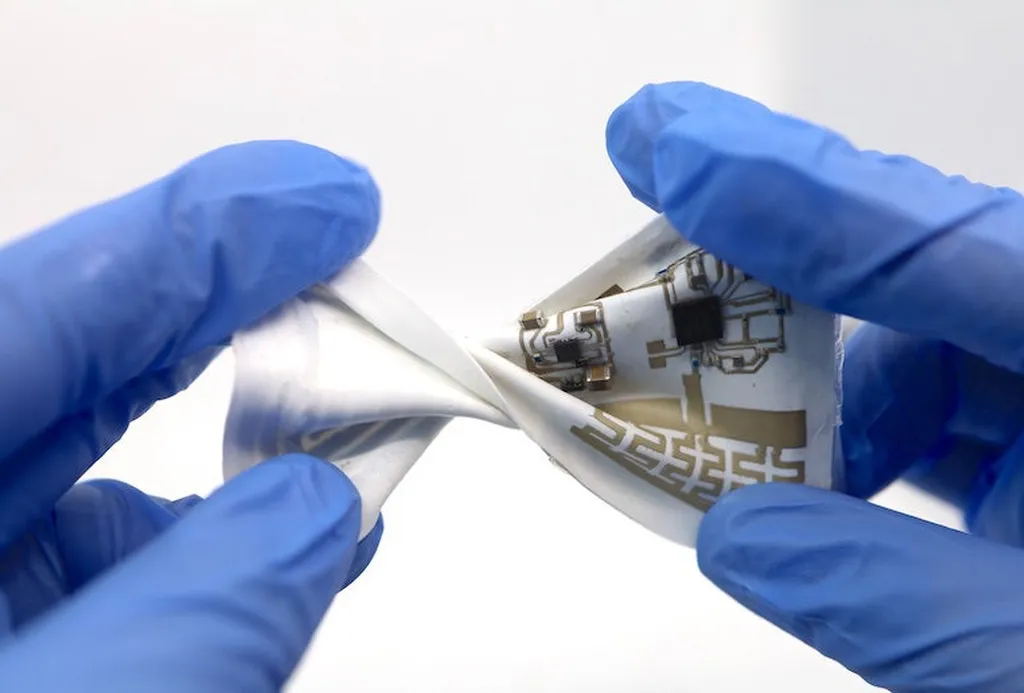
In the ever-evolving landscape of construction and energy sectors, a groundbreaking development has emerged from the labs of Rice University. Nicole Carusetta, a researcher from the Department of Mechanical Engineering, has spearheaded a study that could redefine the way we think about radio-frequency (RF) electronics. Published in the International Journal of Extreme Manufacturing, which translates to the “Journal of Extreme Manufacturing” in English, this research introduces stretchable RF electronics with programmable mechanical and electromagnetic responses.
The implications for the energy sector are profound. Imagine a world where electronic components can adapt to their environment, stretching and conforming to various surfaces without compromising their functionality. This is not just about flexibility; it’s about intelligence. These electronics can be programmed to respond to specific mechanical and electromagnetic stimuli, opening up a plethora of applications in smart grids, renewable energy systems, and even wearable technology for energy monitoring.
Carusetta explains, “Our research focuses on creating electronics that can adapt to their surroundings. This is a significant step forward from traditional rigid electronics. The ability to program their mechanical and electromagnetic responses allows for a level of customization and adaptability that was previously unattainable.”
The potential commercial impacts are vast. In the energy sector, for instance, these stretchable electronics could be integrated into smart grids to monitor and manage energy distribution more efficiently. They could also be used in renewable energy systems, such as solar panels, to optimize energy capture and conversion. Moreover, the adaptability of these electronics could lead to more durable and reliable components, reducing maintenance costs and downtime.
Carusetta further elaborates, “The energy sector is just one area where this technology could make a significant impact. The ability to create electronics that can adapt to their environment opens up countless possibilities for innovation and improvement across various industries.”
As we look to the future, the research conducted by Carusetta and her team could pave the way for a new era of intelligent, adaptable electronics. The potential applications are limited only by our imagination, and the commercial impacts could be transformative. This is not just a step forward; it’s a leap into a new realm of possibilities.