
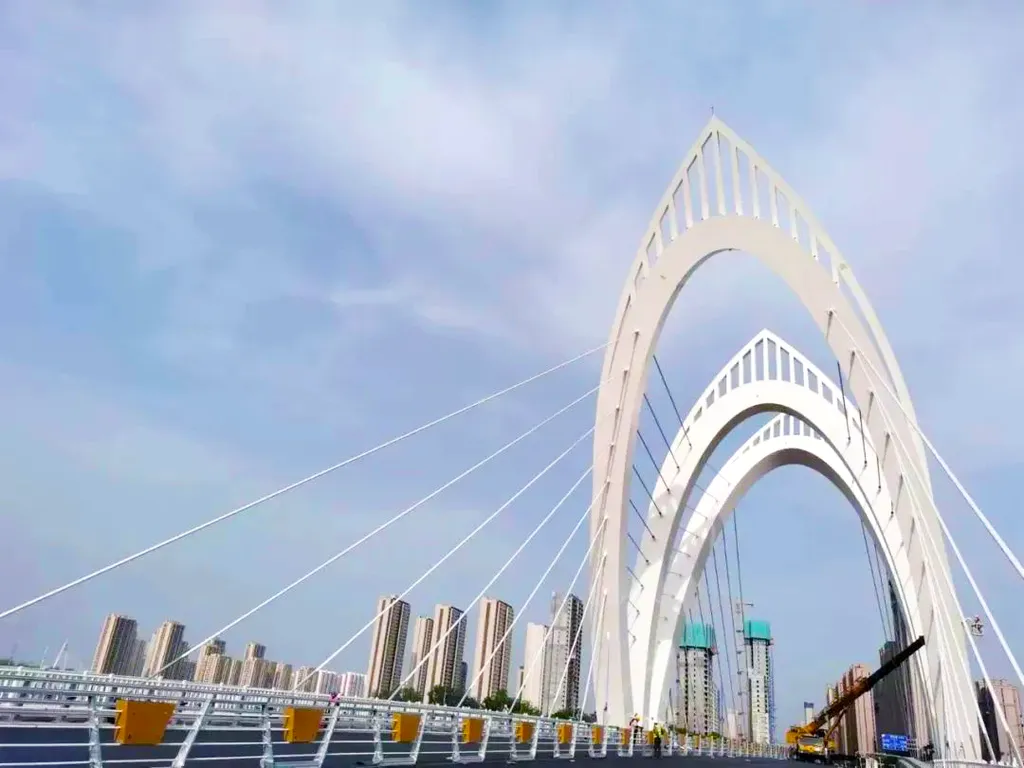
In the ever-evolving world of civil engineering, a groundbreaking method has emerged that promises to revolutionize the way we approach arch bridge construction. This innovative technique, developed by XU Yufeng from the School of Civil Engineering and Transportation at South China University of Technology, combines the forward-back analysis method with the difference iteration method to determine the initial cable tension of arch bridges. The research was recently published in the journal ‘Zhongwai Gonglu’, which translates to ‘China and Foreign Highways’.
The significance of this research lies in its ability to optimize the initial cable tensions, ensuring that the final cable tension meets engineering precision requirements. This is a critical aspect of bridge construction, as the initial cable tension directly impacts the structural integrity and longevity of the bridge. By using the forward-back analysis method, engineers can determine a reasonable set of initial cable tensions based on the known target state of the bridge. These initial tensions are then applied to the calculation model based on the actual construction process. Through the difference iteration method, the initial cable tensions are optimized, significantly saving computation time.
“Our method provides a more efficient and accurate way to determine the initial cable tension,” said XU Yufeng. “This not only saves time but also ensures that the bridge meets the highest standards of safety and durability.”
The commercial implications of this research are substantial. In the energy sector, where large-scale infrastructure projects are common, the ability to optimize initial cable tensions can lead to significant cost savings and improved project timelines. This method can be widely applied to various types of bridges, making it a versatile tool for civil engineers worldwide.
The research paper provides two bridge examples to illustrate the implementation process of the method in practical engineering applications. The results demonstrate the effectiveness of the method in obtaining a set of cable tensions that meet the desired requirements. This validation underscores the potential of the method to shape future developments in the field of civil engineering.
As we look to the future, the application of this method could lead to more efficient and cost-effective bridge construction projects. It could also pave the way for further innovations in the field, as engineers continue to explore new ways to optimize structural design and construction processes. The research published in ‘Zhongwai Gonglu’ is a testament to the power of innovation and the potential it holds for transforming the way we build and maintain our infrastructure.