
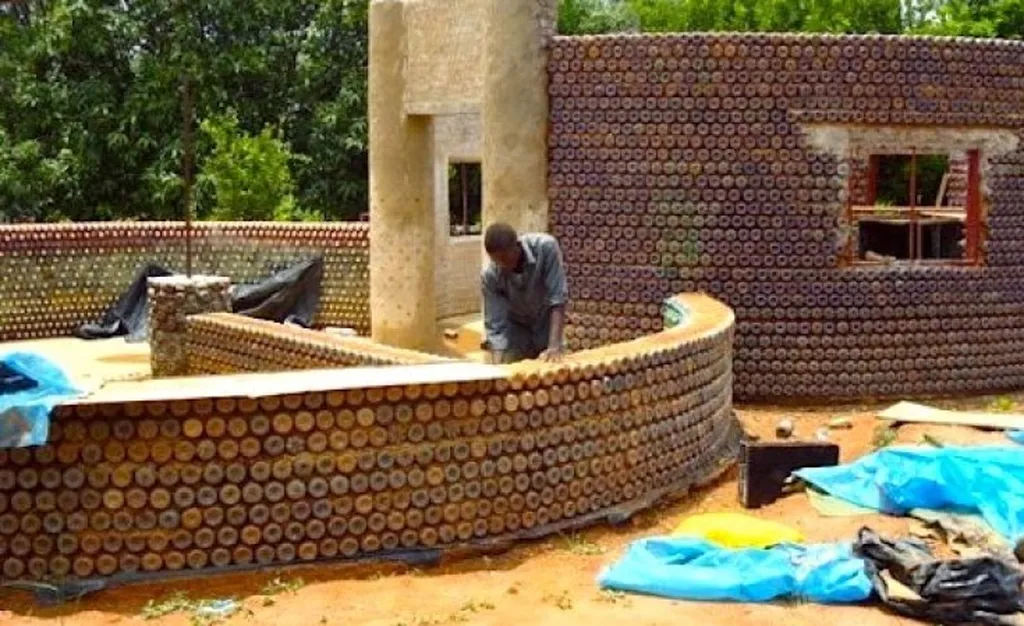
In the heart of Uganda, a novel construction method is emerging that could reshape the housing landscape while tackling two pressing environmental issues: plastic waste and sawdust management. Emmison Eric Masaba, a researcher from the Department of Civil and Environmental Engineering at Kyambogo University in Kampala, has been exploring the potential of Plastic Bottle Brick (PBB) masonry walls as a sustainable alternative to conventional concrete blocks.
Masaba’s study, recently published in the *International Journal of Sustainable Engineering* (translated to English as “Journal of Sustainable Engineering”), delves into the compressive strength and cost-effectiveness of PBB walls, offering a promising solution to Uganda’s substantial housing deficit and escalating construction costs. The research focuses on vertically oriented confined PBB units incorporating uncompressed air, sawdust, and pit sand.
The findings are intriguing. Walls made with pit sand achieved a compressive strength of 0.6 MPa, comparable to hollow concrete block walls. “This is a significant breakthrough,” Masaba explains. “It shows that PBB walls can be just as strong as traditional concrete blocks, but with the added benefit of being more sustainable.”
However, the story doesn’t end there. Walls incorporating sawdust and uncompressed air exhibited lower strengths but demonstrated higher failure strains, indicating a different kind of resilience. “This suggests that PBB walls could offer unique advantages in certain construction scenarios,” Masaba notes.
The cost-benefit analysis is equally compelling. PBB production was found to be commercially feasible, with casting time only 17% slower than conventional block production. “The most economical option was the uncompressed air blocks, costing just USD 3.22,” Masaba reveals. “This makes PBB a viable option for large-scale construction projects, particularly in areas where housing deficits are most acute.”
The implications for the energy sector are substantial. As the world grapples with the environmental impact of traditional construction materials, PBB offers a sustainable alternative that could reduce carbon emissions and promote waste management. “This research could shape future developments in the field,” Masaba concludes. “It opens up new possibilities for sustainable construction, not just in Uganda but globally.”
As the construction industry continues to evolve, innovations like PBB masonry walls could play a pivotal role in building a more sustainable future. With further research and development, these plastic bottle bricks might just become a cornerstone of eco-friendly construction.