
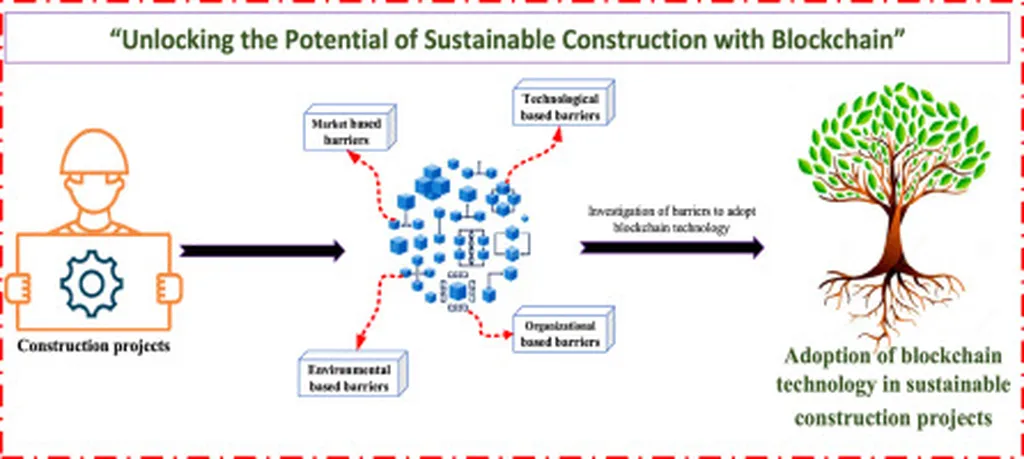
In the rapidly evolving landscape of the construction industry, blockchain technology is emerging as a game-changer, and a recent study published in the *Journal of Civil Engineering and Management* (translated from the original Lithuanian title) sheds light on the factors influencing knowledge sharing in this domain, with a particular focus on the Chinese construction sector. The research, led by Ailing Wang from the School of Management at Zhengzhou University, offers valuable insights that could reshape how construction firms approach knowledge sharing and, consequently, their competitive strategies.
Blockchain technology, known for its decentralized and transparent nature, has the potential to revolutionize various industries, including construction. However, its full implementation has been slow, and knowledge sharing within the sector remains a challenge. Wang’s study aims to bridge this gap by identifying and analyzing the key factors that influence knowledge sharing in blockchain technology within the Chinese construction industry.
The study employs a comprehensive approach, beginning with a thorough literature review and market research to pinpoint the critical factors affecting knowledge sharing. These factors are then classified based on the technology–organization–environment (TOE) framework, which considers the technological, organizational, and environmental contexts in which an innovation is adopted.
One of the standout methods used in this research is the interpretive structural modeling-matrix of cross-impact multiplication applied to classification (ISM-MICMAC) method. This technique allows for the evaluation and prioritization of the identified factors, providing a clear roadmap for industry stakeholders. “By understanding the relationships and dependencies between these factors, construction firms can develop targeted strategies to enhance knowledge sharing and, ultimately, gain a competitive edge,” Wang explains.
The study also highlights the importance of focus group discussions, which were instrumental in exploring the intricate relationships between pairs of factors. This qualitative approach adds depth to the research, ensuring that the findings are not only statistically robust but also grounded in real-world experiences and perspectives.
The implications of this research are far-reaching. For the construction industry, it offers a fresh perspective on how to leverage blockchain technology effectively. By promoting knowledge sharing, firms can foster innovation, improve efficiency, and drive sustainable development. “This study provides practical insights that can help construction companies navigate the complexities of adopting blockchain technology and harness its full potential,” Wang notes.
Moreover, the research contributes significantly to the academic community by advancing the understanding of the factors influencing knowledge sharing. It sets the stage for future studies, encouraging further exploration of this critical area. As the construction industry continues to evolve, the insights from this study will be invaluable for both practitioners and researchers.
In conclusion, Ailing Wang’s research is a timely and relevant contribution to the field of construction management. By focusing on the factors affecting knowledge sharing in blockchain technology, the study offers a roadmap for industry stakeholders to enhance their competitive strategies and achieve sustainable development. As the construction sector increasingly embraces digital transformation, the findings from this research will undoubtedly play a pivotal role in shaping the future of the industry.