
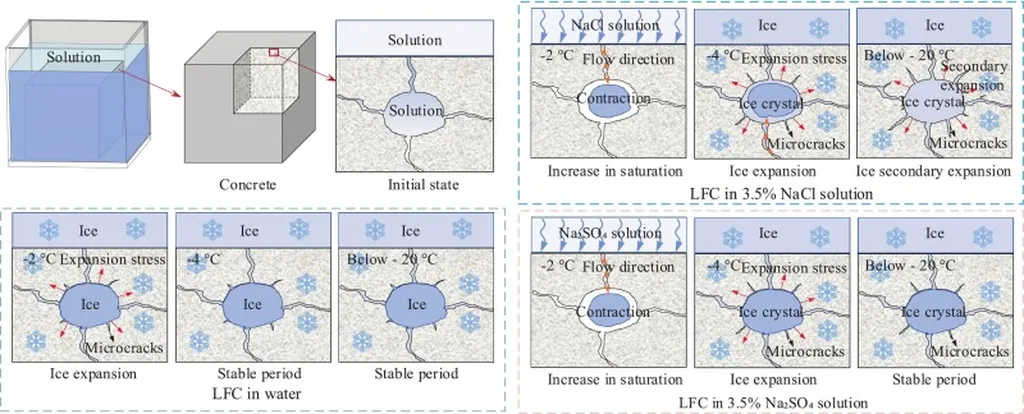
In the relentless battle against concrete degradation, scientists have long sought to understand the microscopic processes that lead to macroscopic damage. Now, a groundbreaking study published in *JPhys Materials* (Journal of Physics Materials) offers a novel perspective on how ice formation in cement paste can lead to structural damage, with significant implications for the energy sector and beyond.
Dr. Katerina Ioannidou, a researcher at the Laboratoire de Mécanique et Génie Civil (LMGC) in Montpellier, France, has developed a sophisticated computational model to simulate the growth of solid phases within the pore network of cement. Her work focuses on the freeze-thaw cycles that concrete structures endure, particularly during harsh winter conditions.
“The formation of ice in cement paste is a complex process that involves both chemical and mechanical aspects,” Ioannidou explains. “Our model combines different simulation techniques to capture the intricate details of this process, providing a comprehensive understanding of the mechanisms driving freeze-thaw damage.”
The study reveals a two-stage growth process: an initial lag phase where isolated ice clusters grow within pores, followed by a rapid growth phase during which the ice clusters percolate through the pore network. This percolation is associated with significant volume expansion and fracture of the cement paste.
“This percolation is a critical point,” Ioannidou notes. “It’s when the ice clusters connect and form a continuous path through the pore network. This is when the real damage starts to happen.”
The implications of this research are far-reaching, particularly for the energy sector. Concrete is a fundamental material in energy infrastructure, from wind turbines to nuclear power plants. Understanding and mitigating freeze-thaw damage can enhance the durability and safety of these structures, reducing maintenance costs and extending their lifespan.
Moreover, the model developed by Ioannidou and her team can be applied to other types of solid precipitation in porous networks, such as the formation of salt crystals or the deposition of minerals. This versatility makes it a valuable tool for a wide range of industries, from construction to environmental engineering.
As we look to the future, this research could shape the development of more resilient and sustainable construction materials. By understanding the microscopic processes that lead to damage, we can design materials that are better equipped to withstand the challenges of their environment.
In the words of Ioannidou, “This is just the beginning. Our model provides a powerful tool for exploring the complex interplay between chemistry and mechanics in porous materials. With further development, it could revolutionize the way we design and build our infrastructure.”