
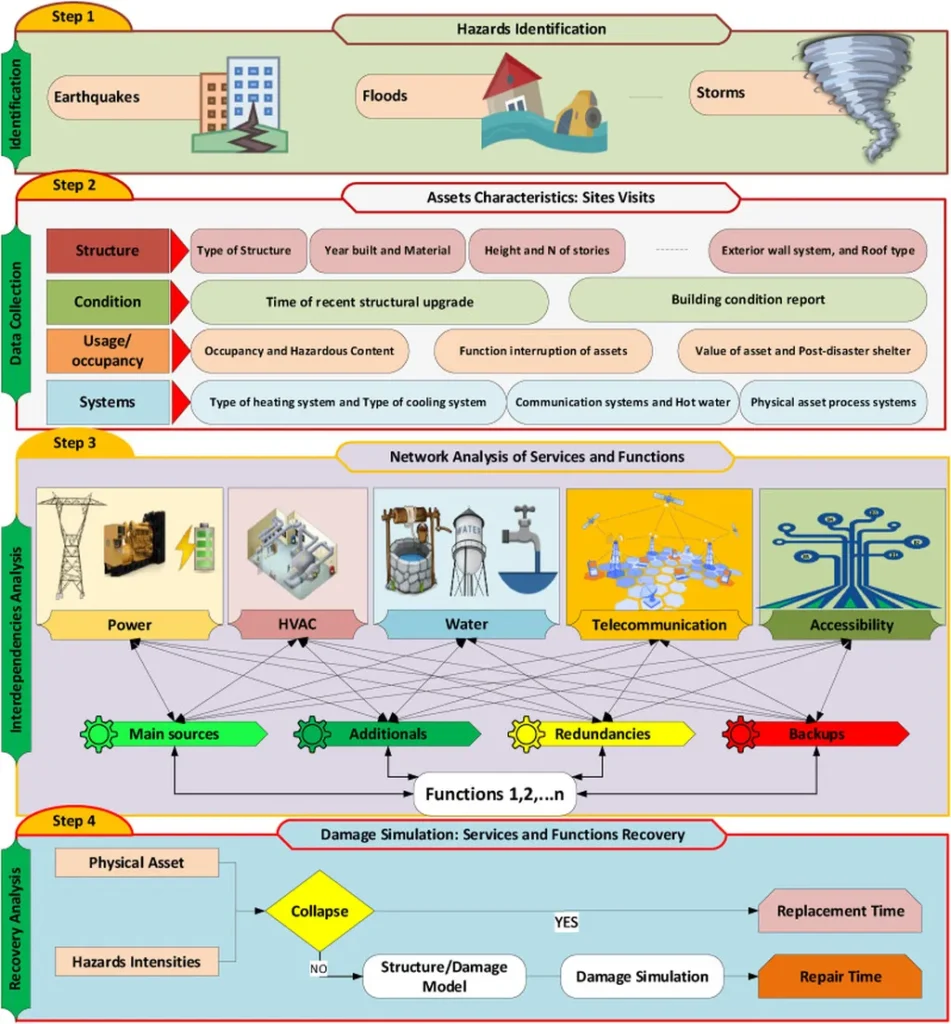
In the heart of China’s Hubei Province, a groundbreaking study led by Qiyuan Wang from the School of Urban Construction and Safety Engineering at Hubei University of Education is reshaping how we understand and prepare for natural hazards. Published in the journal *Geomatics, Natural Hazards & Risk* (which translates to *Geomatics, Natural Hazards & Risk* in English), Wang’s research introduces a comprehensive multihazard assessment framework that could significantly impact disaster prevention and mitigation strategies, particularly for industries like energy that are vulnerable to natural disruptions.
The study focuses on the intricate interplay between droughts, floods, and landslides, hazards that often occur in isolation but can also interact in complex ways, amplifying their overall impact. “Multiple natural hazards often interact in ways that are not fully understood,” Wang explains. “This interaction can lead to compounded effects that are more severe than the sum of their individual impacts.”
To tackle this challenge, Wang and his team developed a framework that systematically integrates single-hazard and coupled-hazard scenarios. By analyzing historical records of natural hazards using association rule mining and hazard coupling process analysis, they identified eight representative scenarios: three single-hazards and five coupled-hazards encompassing alternation, triggering, and compound patterns. For each scenario, tailored hazard assessment formulas were developed to capture the magnitude of the coupling effects.
The application of this framework to Hubei Province revealed that overall multihazard levels are generally low, with high-, medium-, and low-level zones accounting for 26%, 34%, and 41%, respectively. High-level zones are concentrated in the western mountainous regions, where coupling impacts are most pronounced. “This framework provides a more nuanced understanding of hazard interactions, which is crucial for targeted disaster prevention and early warning systems,” Wang notes.
The implications of this research are far-reaching, particularly for the energy sector. Energy infrastructure, such as power plants, transmission lines, and renewable energy installations, is often located in regions prone to natural hazards. Accurate hazard assessment is essential for ensuring the resilience and reliability of energy systems. “By understanding the complex interactions between different hazards, we can better prepare and mitigate potential disruptions to energy infrastructure,” Wang says.
The study’s model evaluation, with an AUC of 0.889 and an accuracy of 0.92, confirms the reliability and scalability of the framework. This robustness offers a solid foundation for future disaster prevention, early warning, and mitigation planning in regions vulnerable to drought, flood, and landslide interactions.
As the energy sector continues to evolve, the need for advanced hazard assessment tools becomes increasingly critical. Wang’s research provides a valuable contribution to this field, offering a comprehensive framework that can be adapted to various regions and contexts. “This framework is not just about understanding the past; it’s about preparing for the future,” Wang concludes.
In an era where natural disasters are becoming more frequent and severe, the ability to accurately assess and mitigate multihazard scenarios is more important than ever. Wang’s research offers a significant step forward in this endeavor, providing a robust tool for disaster management and resilience planning. As the energy sector continues to adapt to these challenges, the insights gained from this study will be invaluable in ensuring the safety and reliability of energy infrastructure.