
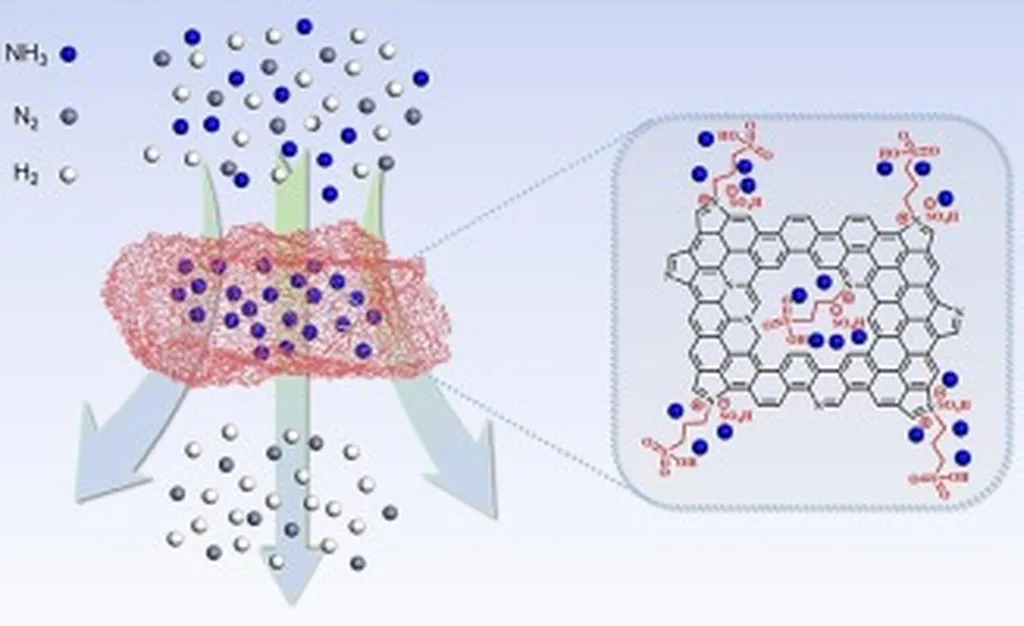
In a significant stride towards enhancing ammonia capture, sensing, and energy conversion, researchers have delved into the intricate world of porous solids, revealing a synergistic effect that could revolutionize the energy sector. The study, led by Yi-Chen Zheng from the College of Ecology at Lishui University in China, critiques the latest developments in porous solids and devices, highlighting their potential to transform industrial processes and environmental protection.
Ammonia, a vital chemical feedstock, plays a crucial role in various industrial processes and serves as a carbon-oxide-free energy conversion medium. However, its efficient capture, sensing, and conversion have posed challenges. Zheng and his team have explored the potential of porous solids, including metal-organic frameworks (MOFs), covalent organic frameworks (COFs), hydrogen-bonded organic frameworks (HOFs), porous organic polymers, traditional inorganic solids, and porous solid catalysts, to address these challenges.
The research, published in the Review of Materials Research (translated to English as “Review of Materials Research”), focuses on the synergistic effect of immobilized interaction sites and versatile integrated functions. This understanding could benefit the design of high-performance devices and the comprehension of the property-structure relationship between guest ammonia molecules and host materials.
“The synergistic effect of these porous solids can significantly enhance adsorption efficiency, sensitivity, and multifunctional integration,” said Zheng. This advancement could lead to more efficient and environmentally friendly industrial processes, contributing to green energy production and human and environmental protection.
The study also highlights the prospects and challenges for the future discovery of advanced porous solid-based devices. Technological innovation in ammonia sensors and energy conversion devices, regarding enhanced performance and multifunctionality, is increasingly significant for the energy sector.
As the world grapples with the need for sustainable energy solutions, this research offers a promising avenue for exploration. The insights gained could shape future developments in the field, driving innovation and progress towards a greener, more efficient energy landscape. The commercial impacts of this research could be substantial, with potential applications in various industries, from agriculture to energy production and environmental protection.
In the words of Zheng, “The understanding of these property-structure relationships can guide the rational design of advanced porous solids and devices, paving the way for a more sustainable future.” This research not only advances our scientific understanding but also brings us one step closer to achieving our environmental and energy goals.