
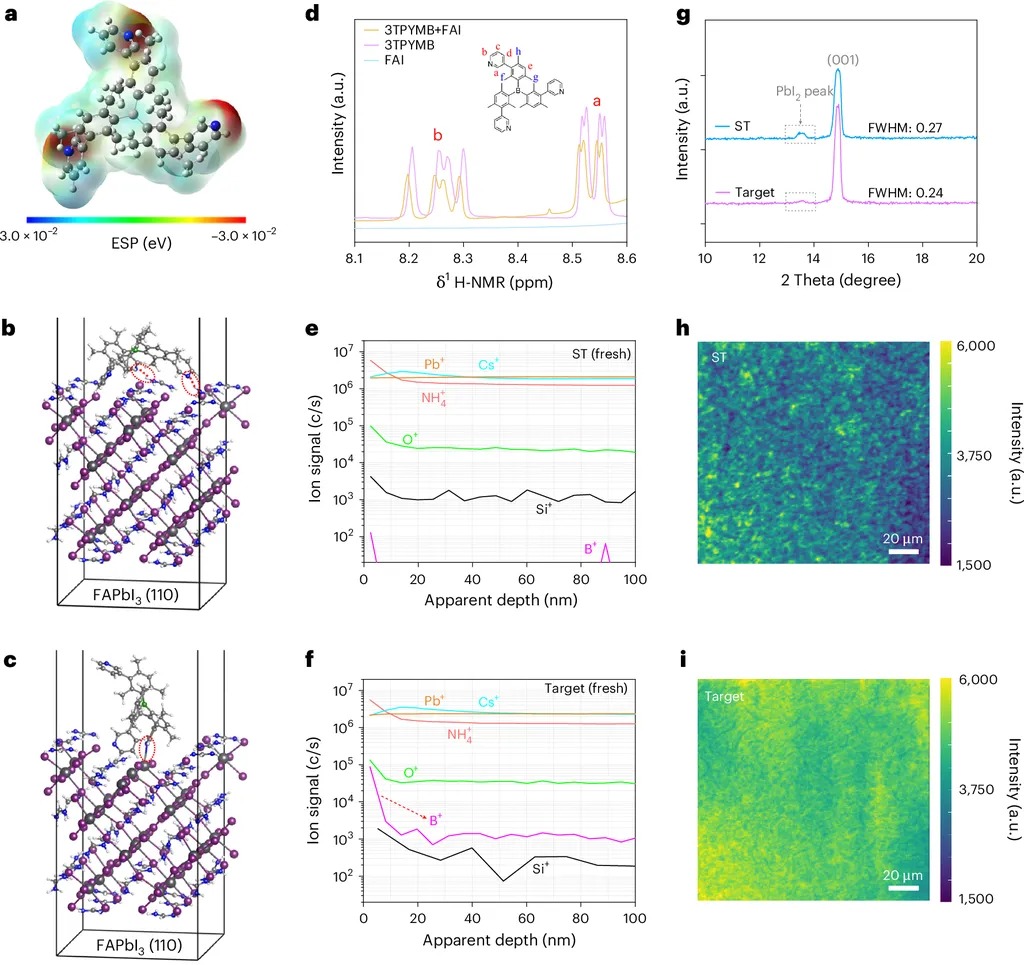
In a significant stride towards enhancing the performance and stability of perovskite solar cells (PSCs), researchers have unveiled an innovative in situ chemical modulation strategy. This breakthrough, published in the journal *Materials Futures* (translated as “Materials Horizons”), could potentially revolutionize the energy sector by addressing key limitations that have hindered the commercialization of PSCs.
The study, led by Jiajia Du from the Key Laboratory of Display Materials and Photoelectric Devices at Tianjin University of Technology and the Shandong Provincial Key Laboratory for Science of Material Creation and Energy Conversion at Shandong University, focuses on the disordered crystal growth and degradation of perovskite films. These issues have been major roadblocks in improving the efficiency and longevity of PSCs.
Du and her team proposed an in situ modulation strategy that adjusts the phase transformation kinetics to prepare high-quality and stable perovskite films. “By introducing chloroformamidinium hydrochloride (ClFACl) and facilitating its reaction with formamidinium (FA) cations, we were able to inhibit the impurity intermediate phase and induce the α-FAPbI₃ phase to grow along a preferred (001) orientation,” Du explained. This process strengthens the intermolecular interactions within the crystals, thereby enhancing the films’ resistance to humidity and thermal degradation.
The implications of this research are profound for the energy sector. Perovskite solar cells have long been touted for their potential to offer high efficiency at a low cost. However, their commercial viability has been hampered by issues related to stability and performance. The in situ chemical modulation strategy developed by Du’s team addresses these challenges head-on.
“With crystal orientation optimization and defect reduction, the PSCs with in situ formed FA–Gua yields a champion efficiency of 25.85% and demonstrates excellent phase stability under long-term thermal and humid aging conditions,” Du noted. This level of efficiency and stability brings PSCs closer to meeting the stringent requirements for commercial applications.
The research not only paves the way for more efficient and stable PSCs but also offers a new avenue for optimizing crystallization orientation and α-phase stabilization. This could lead to further advancements in the field, potentially making perovskite solar cells a mainstream energy solution.
As the world continues to seek sustainable and renewable energy sources, innovations like this are crucial. The work of Jiajia Du and her team, published in *Materials Futures*, represents a significant step forward in the quest for efficient and stable solar energy solutions. The energy sector is watching closely, as this research could shape the future of solar technology and contribute to a more sustainable energy landscape.